
The DGNB is committed to the sustainable and future-proof development of the built environment. In light of climate change and the environmental, social and economic challenges we face, the building sector has a key role to play in this regard. The objective is to reduce emissions and resource consumption, to make the built environment resilient, whilst ensuring a high quality of life and long-term economic viability.
Through its DGNB Certification System, the DGNB creates a holistic framework for this and pursues this objective beyond the German market at an international level. Projects outside Germany are certified by the DGNB using the international version of the DGNB System presented here. This can be easily adapted to the climatic, structural, legal and cultural characteristics of other countries.
The international version of the DGNB System takes into account key regulatory requirements and frameworks such as the EU taxonomy, the EU's Energy Performance of BuildingsDirective (EPBD), the United Nations Sustainable Development Goals (SDGs) and relevant, internationally recognised ISO standards. The DGNB System New Construction, Buildings, Version 2026 International can serve as evidence of compliance with green finance criteria, since it allows the key metrics required for reporting to be derived. In this way, DGNB Certification brings together various requirements within a single system.
Key points of the DGNB System for New Construction, Buildings, Version 2026 International at a glance
The 2026 international version of the DGNB System for New Construction, Buildings is aimed at anyone planning, constructing and/or owning a new building in countries outside Germany where DGNB does not have a local system partner. This may include project development firms, housing associations, investors, building owners, local authorities or private individuals. The system is more than just an assessment tool. It is designed as a tool for design and optimisation. The certification helps to ensure that all key aspects of holistic sustainability are taken into account at an early stage, to resolve any conflicting objectives that arise and to proactively avoid future risks.
The DGNB System for New Construction, Buildings, Version 2026 International is applicable to the following schemes:
- Educational buildings
To the scheme
- Office and administrative buildings
To the scheme
- Department stores
To the scheme
- Healthcare buildings
To the scheme
- Hotels
To the scheme
- Logistics buildings
To the scheme
- Mixed use
To the scheme
- Production buildings
To the scheme
- Shopping centres
To the scheme
- Consumer markets
To the scheme
- Assembly buildings
To the scheme
- Residential buildings (more than 6 residential units)
To the scheme
Please note: For small residential buildings with up to 6 residential units the current DGNB System for the Renovation or New Construction of small residential buildings (up to 12 residential units), Version 2024, applies.
Benefits of certification for new builds
- Independently audited and guaranteed quality
- Differentiation from competitors
- Use as part of communication strategies
- Good potential for repurposing
- Lower vacancy rates
- High levels of comfort
Advantages of the DGNB Certification System
- Alignment with international systems, standards and European regulatory frameworks (e.g. EU taxonomy, Level(s), SDGs, EPBD)
- High flexibility and adaptability to different regional framework conditions
- Taking into account existing local regulations, requirements and evaluation systems
- Evaluation of the environmental impacts of buildings throughout their entire life cycle
- Guidance for the certification of projects without completed interior fittings (DGNB Certificate 'Construction Ready')
The DGNB is committed to creating a sustainable built environment. Its aim is nothing less than transforming the construction and real estate industry – towards a meaningful understanding of quality as the basis for responsible, sustainable action. In pursuing this objective, the DGNB does not focus solely on the German market. Its activities have always been international in scope.
The DGNB System for New Construction, Buildings, Version 2023.2, is closely aligned with the legal requirements and standards in Germany, as well as with the quality label "Qualitätssiegel Nachhaltiges Gebäude" (QNG) (i.e. Quality Seal Sustainable Building). To take into account the diverse requirements worldwide, the DGNB has developed a certification system for new construction which, thanks to its flexibility and adaptability, is precisely tailored to this diversity. In doing so, the international version of the DGNB System for New Construction retains the overarching objectives and holistic philosophy whilst adapting the technical framework to international requirements.
The international version of the DGNB System for New Construction places greater emphasis on regional conditions, including local standards and legal requirements, available materials, climatic conditions, regional water availability and regional cost factors. This enables the sustainability criteria to be applied effectively in different geographical, regulatory and economic contexts.
Quick links: Criteria | Certification requirements and award | Further information | Project registration | FAQ
Certification criteria
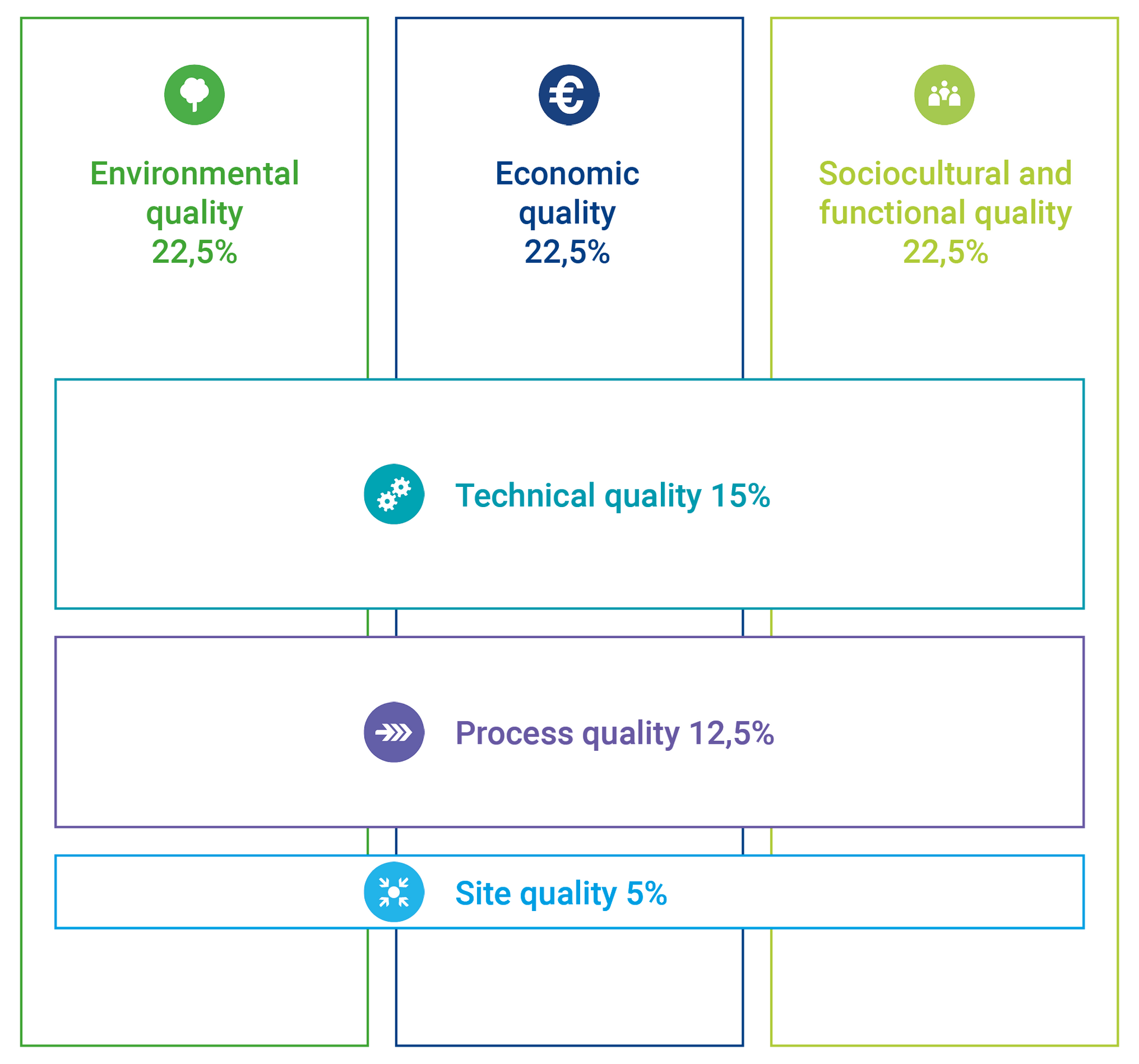
Rather than assessing individual measures, constructions or building components, the DGNB System evaluates a building's overall performance based on specific criteria. It is based on three key sustainability areas: ecology, economy and socio-cultural aspects. Each topic area accounts for 22,5 per cent of the overall evaluation. As part of a holistic approach, the DGNB System also evaluates the site (5 per cent of the overall evaluation) and technical and procedural quality (15 and 12,5 per cent of the overall evaluation ).
In total, the system covers 32 criteria, broken down by topics as follows:
- Environmental quality: 6 criteria
- Economic quality: 4 criteria
- Socio-cultural and functional quality: 7 criteria
- Technical quality: 6 criteria
- Process quality: 6 criteria
- Site quality: 3 criteria
The criteria set of the previous 2020 version is available for download here.
Certification requirements and award
At the time of certification, the building should not have been completed or commissioned more than three years ago. If it is intended to certify a new building that was completed or commissioned more than three years ago, this must be agreed with the DGNB office via a project-specific request for certifiability (PCQ) by a DGNB Auditor before the project is registered. As a rule, it is always possible to certify a building according to a scheme eligible for new construction.
The principle of minimum requirements applies to all those aspects that are non-negotiable for a sustainably planned and constructed property, with a view to its future viability.
Minimum requirements based on criteria for all buildings:
- Climate Action Roadmap (minimum requirement in accordance with ENV1.1, Indicator 3.2) and disclosure of life cycle assessments (Indicator 3.1.1)
- Indoor air quality (minimum requirements in accordance with SOC1.2)
- Design for all (minimum requirements in accordance with SOC2.1)
- Fire safety (minimum requirements in accordance with TEC1.1)
- Statutory requirements: The statutory requirements applicable to the building to be certified
must be met.
Where individual regulations regarding minimum requirements exist for specific schemes, these are listed in the criteria set under the section ‘Scheme-specific information’.
Primary use: The scheme with the largest share of the total DGNB assessment area is designated as the primary use. In the case of mixed use, the scheme with the largest share of space is designated as the primary use. If classification is not clearly possible (e.g. 40 per cent office, 40 per cent residential, 20 per cent commercial building), the auditor must determine the primary use and justify the decision.
Secondary use: One or more uses that are assigned to a different scheme than the primary use and whose area share of the total DGNB assessment area is ≥ 15 per cent are referred to as secondary use. The areas of a secondary use must be evaluated with the corresponding scheme. If there is at least one secondary use, the building under consideration must be evaluated according to the mixed use application rules.
Subordinate use: One or more uses that are assigned to a different scheme than the primary use and whose area share is < 15 per cent (or in case of several schemes < 30 per cent) of the DGNB assessment area are referred to as subordinate use. These areas are to be assigned to the primary use and are to be evaluated according to the primary use scheme. If there are several secondary uses < 15 per cent of DGNB assessment area and the sum of their area shares in the DGNB assessment area is ≥ 30 per cent, the subordinate use with the largest area share is to be considered as secondary use.
Award
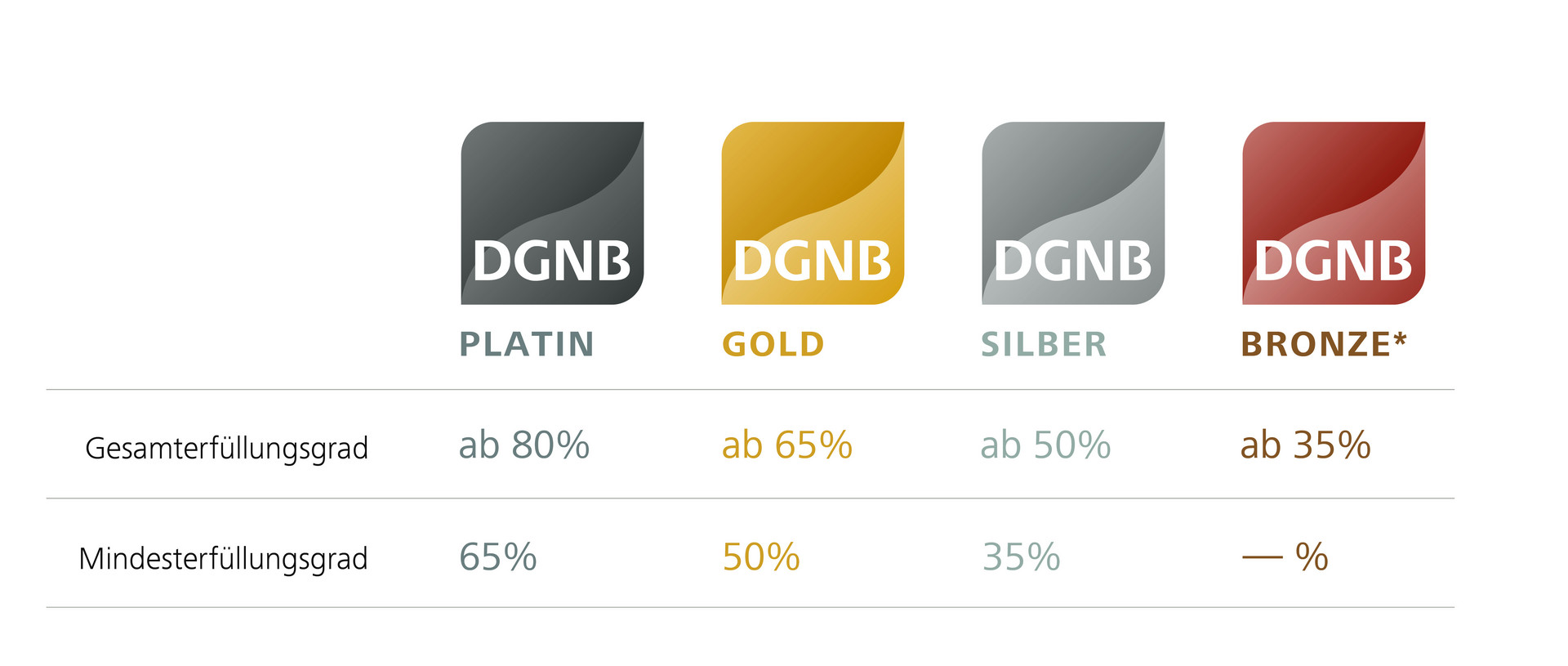
As with the other DGNB Certification Systems, the DGNB System for New Construction, Buildings, Version 2026 International evaluates performance indices. The total performance index is calculated based on the evaluation of the individual criteria. The highest award level is Platinum.
From an total performance index of 50 percent, the building receives the DGNB Certificate in Silver. From a total performance index of 65 percent, the DGNB Certificate in Gold is awarded. For a DGNB Certificate in Platinum, the project must achieve a total performance index of at least 80 percent.
The DGNB aims to promote a uniformly high quality of buildings. The total performance index alone is therefore not sufficient for a certificate. In the topic areas of ecological, economic as well as socio-cultural and functional quality, a minimum performance index must be achieved in each topic area in order to receive the corresponding award. For Platinum, for example, a minimum performance index of at least 65 percent is required in these first three subject areas. A minimum performance index of at least 50 percent is a prerequisite for a certificate in Gold. For Silver, the threshold is 35 per cent per topic area.
Introducing the DGNB System for New Construction – Version 2026 International
- Time:14:30 - 15:30
- Price: free
- Organiser: DGNB
- Language: English
Project registration
To register a project, contracting parties must first engage a DGNB Certification expert. This expert can then register the project. Certification experts also oversee the entire process and are responsible for compiling the supporting documentation and submitting it to the DGNB.
Note on registration for earlier system versions
Since 27 May 2026, it has been possible to register for the updated 2026 version. Since then, the 2026 version has completely replaced the 2020 version.
For projects already registered, the system version valid at the time of registration applies. However, the DGNB recommends switching to the new version in consultation with the certification body.
Selected DGNB-certified projects
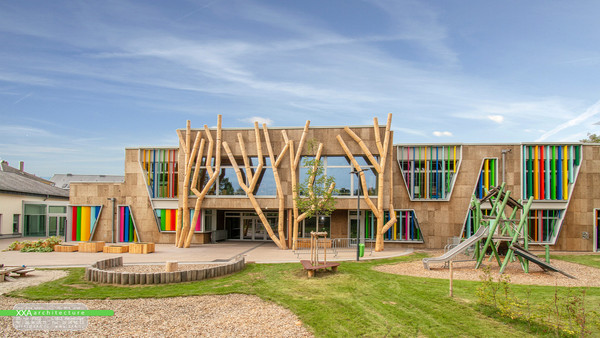

Educational Buildings
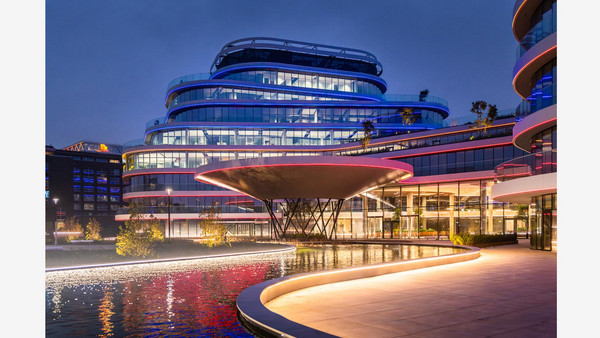

Offices and Administriative Buildings
Further information
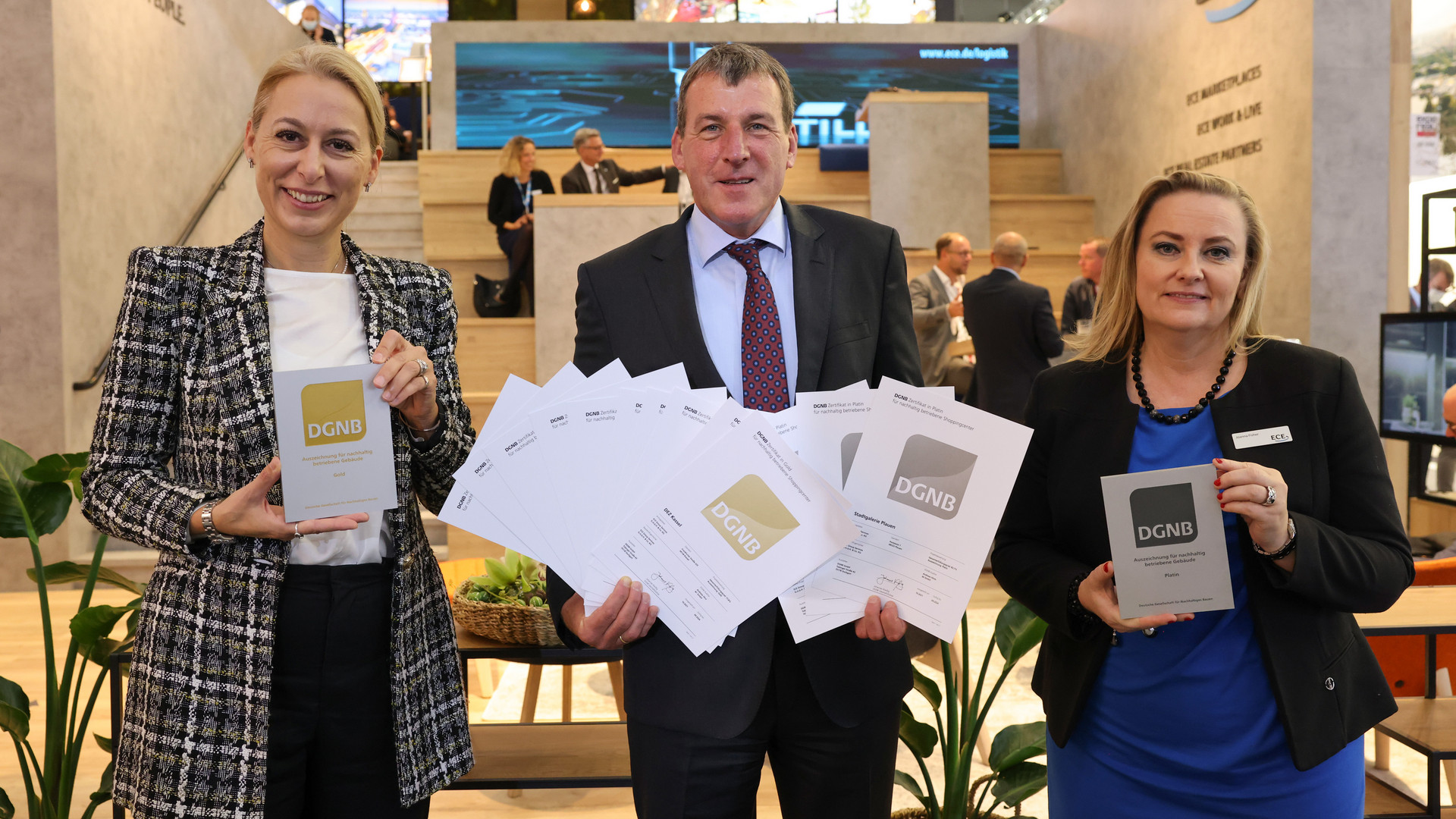
Certifying multiple projects
The DGNB System allows for the certification not only of individual buildings but also of multiple buildings. This may be of interest to clients seeking a simplified certification process for buildings of a similar nature. The DGNB offers three different types of certification for this purpose, depending on the nature of the enquiry.

International DGNB Consultant
With the training to become an International DGNB Consultant, you will qualify as an accredited expert for DGNB Certification in an international context. The training prepares you to apply and optimally implement the requirements of certification in the design, planning and construction process of buildings and districts according to the international version of the DGNB System in practice. The focus is on adapting the DGNB System to the specific local requirements in new markets.
Driving the green transformation in Europe
Frequently Asked Questions about the DGNB System for New Construction, Buildings, Version 2026 International
General updates and optimised applicability
In addition to numerous refinements to the requirements for adaptation to current norms, standards and guidelines (e.g. Energy Performance of Buildings Directive, or EPBD for short), great importance was attached to optimising user-friendliness and accessibility during the revision of the criteria set. The new version therefore now comprises only 32 criteria instead of the previous 38. The reductions are mainly the result of optimisations through reorganisation, the elimination of redundancies and efforts to optimise the assessment process without compromising on ambitions. The following criteria have been removed or integrated into other criteria: SOC1.5, TEC1.2, TEC1.7, PRO2.2, PRO2.4, PRO2.5 and SITE1.2. The criterion ECO2.6 is new.
Compatibility
In addition, great importance was placed on compatibility with European assessment systems during further development. The revised version of the system is fully harmonised with the requirements of the EU taxonomy and closely aligned with the Level(s) reporting framework and the UN's Sustainable Development Goals (SDGs). This makes it possible to comply with the requirements of all systems seamlessly. For a better overview, criteria relevant to the aforementioned assessment systems are marked with individual symbols in the criteria set.
Local adaptability
Another major focus of the revision was to optimise adaptability to local requirements and conditions. All criteria are based on internationally recognised benchmarks and draw predominantly on ISO and EN standards. Where technically possible, the new system version also allows local standards and regulations, local availability of materials, cost factors and climatic conditions to be taken into account for all criteria. This ensures that the criteria can be applied effectively worldwide despite differing geographical and economic conditions. For criteria that may require a particularly high degree of adaptation, this was taken into account when designing the criteria. These criteria are marked with a special symbol in the criteria set.
Overarching requirements
The DGNB aims to certify buildings that meet the highest ethical, social and environmental standards and prioritise the well-being of communities and the general public. Our certification process takes into account the far-reaching impact of buildings on all stakeholders, including users, neighbours, investors and owners. In the new version of its international system for the new construction of buildings, the DGNB has therefore explicitly laid down key principles and standards in the system basics that must be fully taken into account by all projects. These relate to labour standards and the well-being of employees, social justice and community empowerment, cultural and environmental responsibility, ethical business practices as well as resilience and sustainable development.
For the DGNB System for New Construction, Buildings, Version 2026 International the current scale of fees for new construction applies.
From 27 May 2026, Version 2026 completely replaces the 2020 version as the valid international market version. Registration under the 2020 version is no longer possible.
Exceptions apply to the following categories: existing series or multiple certification projects, projects that have already been registered, projects with an existing PCQ number, and projects that have already been reviewed by the DGNB and have received written confirmation that they may proceed.
Yes, you can switch at any time.
Please note the following:
- Please let us know that you wish to switch by emailing system@dgnb.de
- Contracting parties will then receive an addendum to their existing contract.
- However, documents for project submission must still be submitted on paper or via file transfer.
All tools are available directly within the DGNB System Software and are currently in the beta phase. Once the technical tests have been completed, the first release versions will be published by the end of 2026. The assessment matrix for the 2026 version is also available and provides certification experts with an easily accessible overview, as well as an assessment tool that can be used within the DGNB System Software without the need to log in.
The development of the DGNB System for New Construction, Buildings, Version 2026 International took into account the integration of the current requirements of the EU taxonomy. Parallel processing is possible. In the system basics, you will find a process description explaining how the DGNB ensures that the system remains up to date in the event of future revisions (e.g. to the EU taxonomy requirements).