
Building owners, portfolio managers and operators who want to ensure the future viability of their buildings cannot ignore the need for sustainable optimisation of building operations.
This is not only important in the light of increasing reporting requirements and constantly evolving regulatory conditions. Systematic optimisation of your property operations based on certification enables, among other things, a predictable path towards carbon neutrality, long-term optimised operating costs, more efficient use of resources, minimised risks, increased investment security, value retention and greater user satisfaction. When applied to entire portfolios, stakeholders also benefit from the transparency, comparability and comprehensively optimised processes that are achieved. The most important thing is to get started. This is precisely where the DGNB System for Buildings In Use provides support.
The DGNB System for Buildings In Use supports you in systematically planning and implementing the transformation of your existing properties. It starts with a comprehensive assessment of the status quo of the buildings in the sense of an assessment of the existing properties. Based on this, the system supports you as a management and optimisation tool in achieving continuous improvement in the most important aspects of sustainability that are relevant to operations and can be influenced and optimised. In line with the 'Plan-Do-Check-Act' principle, certification helps you to tap into all the potential for improvement in your existing properties in terms of climate action and sustainability in a cost-efficient and targeted manner, thereby becoming demonstrably fit for the future.
The certification addresses all stakeholders — owners and operators as well as users of the building. The certification system is not only suitable for individual buildings and flagship projects. It can also be used effectively for portfolio management by large property owners, such as those in the housing industry or local authorities.
The system specifically addresses: portfolio managers, asset managers, property managers, building owners, investors, owner-occupiers, real estate/corporate real estate managers, operators, and facility managers, as well as cities and local authorities.
Added value gained from certification of building operations
- Transparency regarding building performance and operating processes
- Risk minimisation and value preservation of the property or properties
- Cost savings, in particular reduction of life cycle and operating costs
- Development of a long-term property and portfolio strategy
- Systematic approach and holistic view: creation of a building-specific plan that includes all necessary measures to ensure the future viability of the building
- Support in adapting to climate change and current and future regulations
Advantages of the DGNB Certification System
- Application as a management and optimisation tool for actual building performance
- Applicability for individual buildings and portfolios
- Harmonisation of criteria with European standards (EU Taxonomy, ESRS, CSRD, CRREM)
- Integration of key performance indicators from industry standards such as RICS and ZIA
- Information on key figures required for building assessment and reporting based on standardised documentation
- Transparency regarding the continuous improvement of building performance through the recertification process and application of the 'Plan-Do-Check-Act' principle
- Easy integration of processes into business workflows and other management systems through the 'Plan-Do-Check-Act' principle
- Predictable reduction of CO2 emissions from the property or properties
- Option for standardised documentation and sustainability assessment of properties (e.g. using the NIMMO assessment system)
- Process that motivates owners and investors to invest in optimisation measures
- International applicability (joint development with European DGNB System Partners) and adaptability to country-specific characteristics
Quick navigation: Criteria | Certification aids | Requirements, award and recertification | Application for portfolios | Project registration | FAQ
Certification criteria
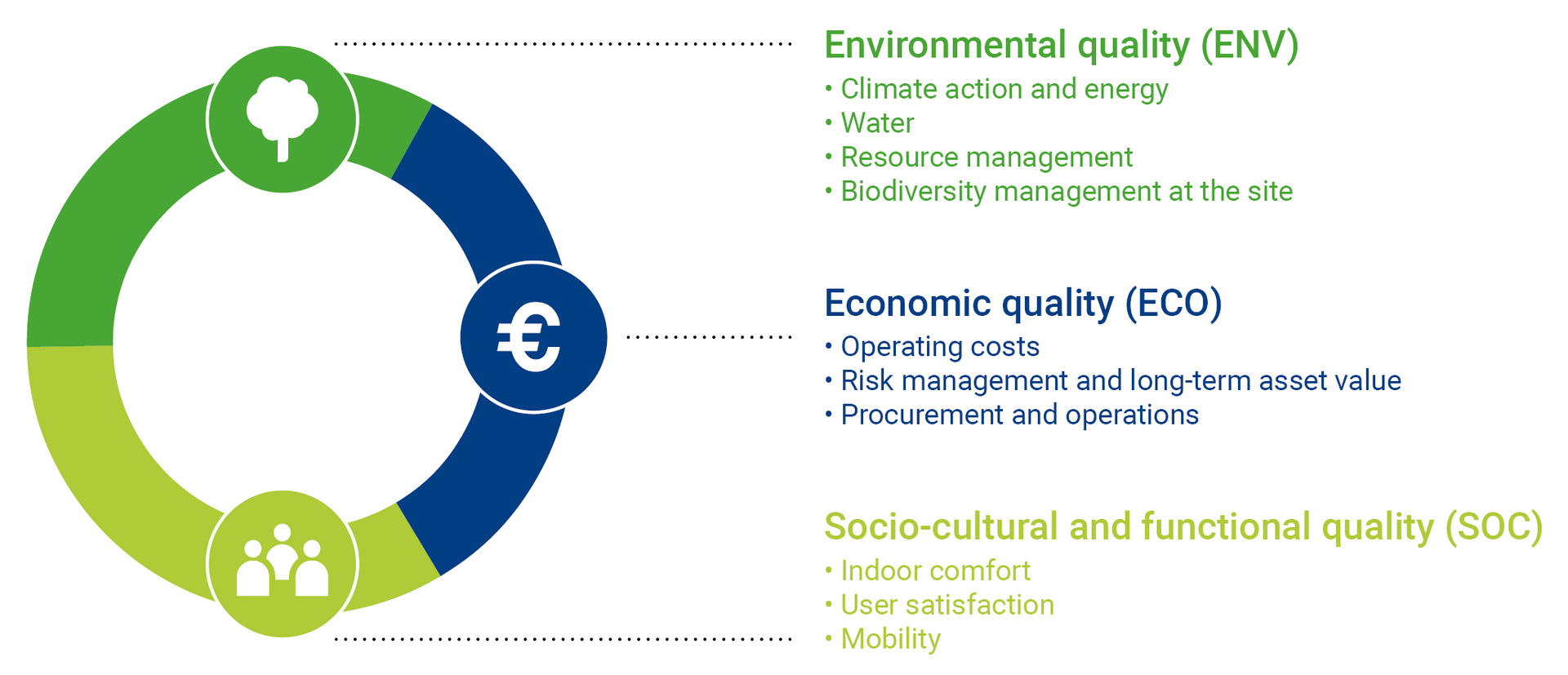
The DGNB System for Buildings In Use focuses on all relevant aspects of sustainable building operation and long-term value retention in just ten criteria from three topic areas. The basic structure of the DGNB System for Buildings In Use is based on the well-known three-pillar model of sustainability and divides the essential aspects of sustainable building operation into the topic areas of environmental quality, economic quality as well as socio-cultural and functional quality.
The subject areas are weighted as follows:
- Environmental quality: 40 per cent
- Economic quality: 30 per cent
- Socio-cultural and functional quality: 30 per cent
Continuous improvement: Plan-Do-Check-Act
The criteria in the DGNB System for Buildings In Use are predominantly structured according to the ‘Plan-Do-Check-Act’ management system:
- Plan: Set specific targets for the respective criteria
- Do: Record measured values and consumption data
- Check: Evaluate data
- Act: Assess target achievement and define individually tailored measures for optimisation
This approach ensures a continuous improvement process. Based on this criteria structure, the DGNB not only assesses the measures implemented and the degree to which targets have been achieved, but is also able to reward the path taken to get there.
Application within the scope of initial certification (complete data for three years):
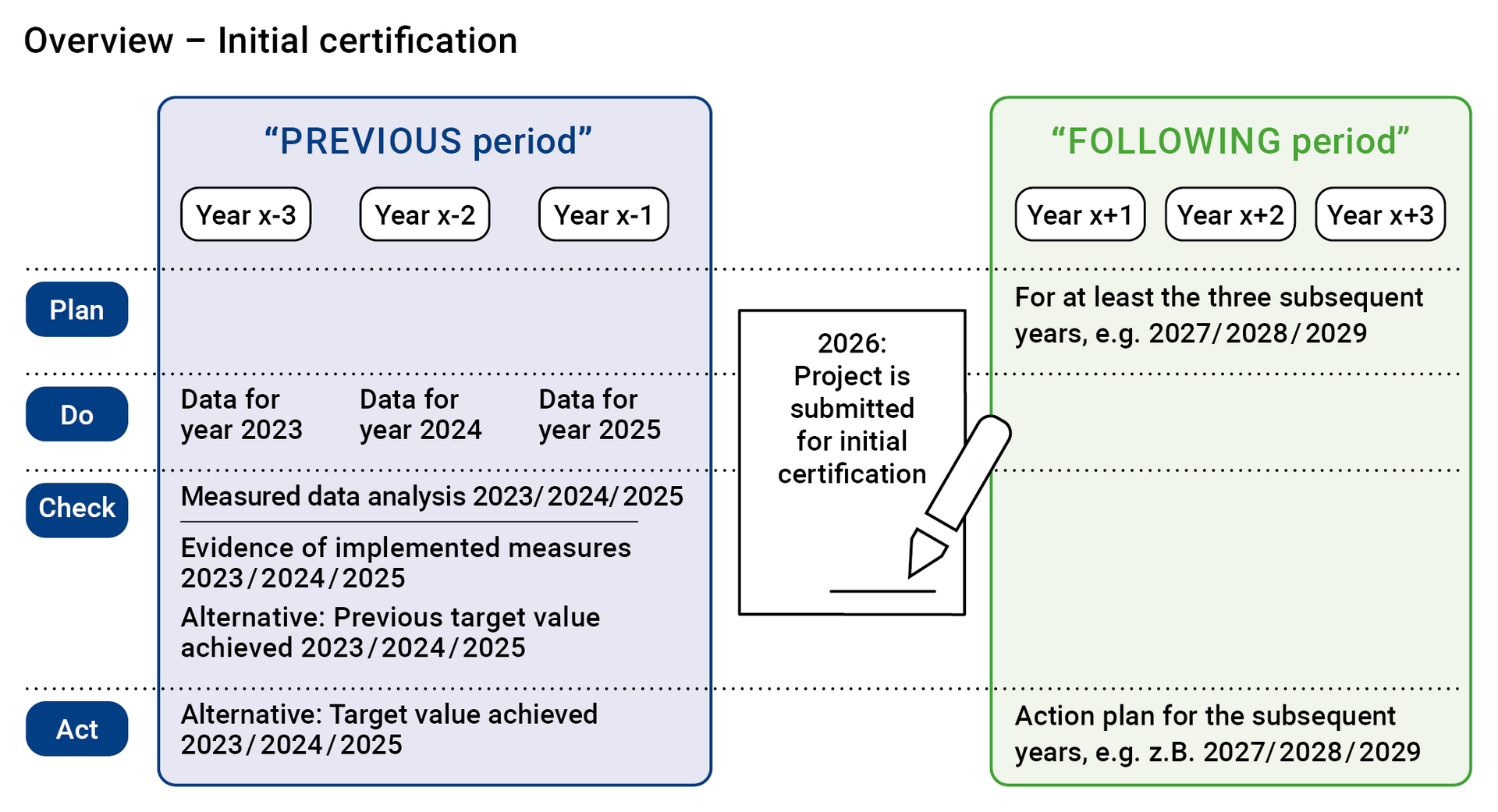
- Plan: It is evaluated whether a target has been defined for the next three years (including the current year).
- Do: It is evaluated whether at least a year's worth of representative measurement data is available.
- Check: It is evaluated whether a data analysis has been performed on the basis of the consumption data. It is also evaluated whether measures have been implemented during the previous one to three years.
- Act: A catalogue of measures has been created.
Application within the scope of recertification
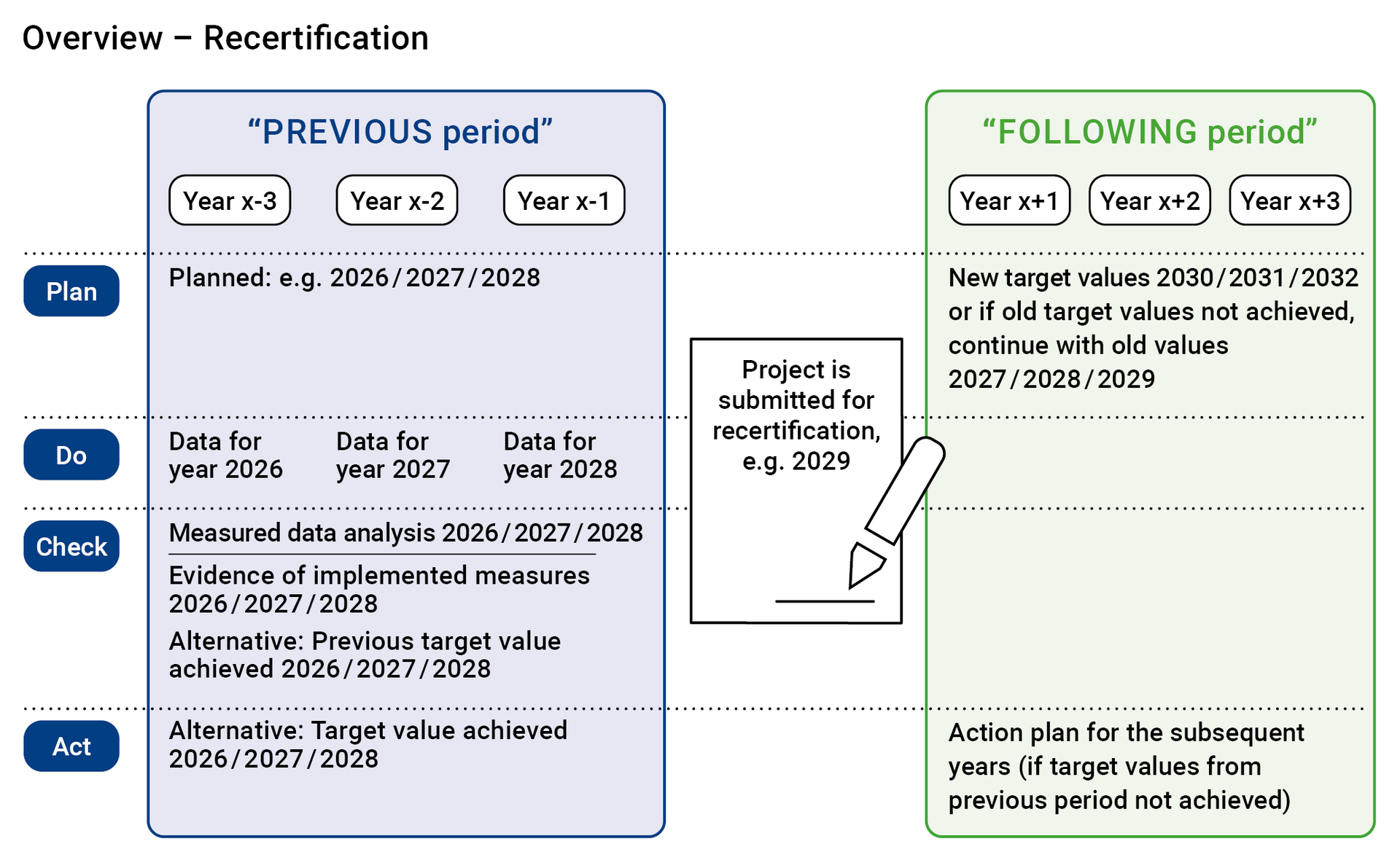
- Plan: A check is carried out to determine whether the target value has been achieved; either a new target value is set or the current one is retained.
- Do: It is evaluated whether at least a year's worth of representative measurement data is available.
- Check: A data analysis is performed based on the data submitted as part of the “Do” step. A check is carried out to see whether planned measures have already been implemented during the previous one to three years. A check is also performed to determine whether the target value was achieved in the previous period.
- Act: A check is carried out to determine whether the target value has been met. If it has, no new measures are necessary. Otherwise, new measures must be defined.
Where targets based on external specifications have been achieved, these can be documented and recognised within the context of both initial certification and recertification processes.
Certification aids
DGNB-recognised services: the simplified path to a DGNB Certification for Buildings In Use
The DGNB-Recognised Service provides clarity on the contribution of standardised services within the DGNB Certification for Buildings In Use framework. Services carrying the label have already undergone pre-testing as a so-called certification module based on the DGNB System for Buildings In Use. This allows you to see at a glance which indicators are covered by the use of a recognised service.
Work aids for climate risk analysis and climate adaptation
- Collection of freely available online resources on environmental hazards caused by climate – nature – civilisation
- List of providers and products for professional climate risk services (assessment – management – reduction)
- Overview of possible adaptation measures for climate hazards (heat – drought | heavy rain – flooding | thunderstorms – hail)
Certification requirements
At the time of certification, the building must have been in use for at least one year. However, prior certification of the new building is not necessary. In addition, all buildings submitted to the DGNB for conformity checks must comply with applicable legal regulations.
Evaluation and award
Like other DGNB Systems, the DGNB System for Buildings In Use assesses buildings according to their degree of fulfilment. The total degree of fulfilment is calculated from the assessment of the individual criteria. The highest award is the Platinum Certificate. Buildings with a total degree of fulfilment of 35 per cent or more receive the DGNB Bronze Certificate. The DGNB Silver Certificate is awarded for a total degree of fulfilment of 50 per cent or more. To receive the DGNB Gold Certificate, the project must achieve a total degree of fulfilment of at least 65 per cent. A DGNB Platinum Certificate is awarded for a total fulfillment level of 80 per cent or higher, provided that it has also been demonstrated that the technical criteria for climate change mitigation and adaptation have been met according to the EU taxonomy criteria for environmentally sustainable economic activities in the economic sector 'acquisition and ownership of buildings'.
The certificate is valid for three years from the date of issue and can only be extended through recertification.
Recertification
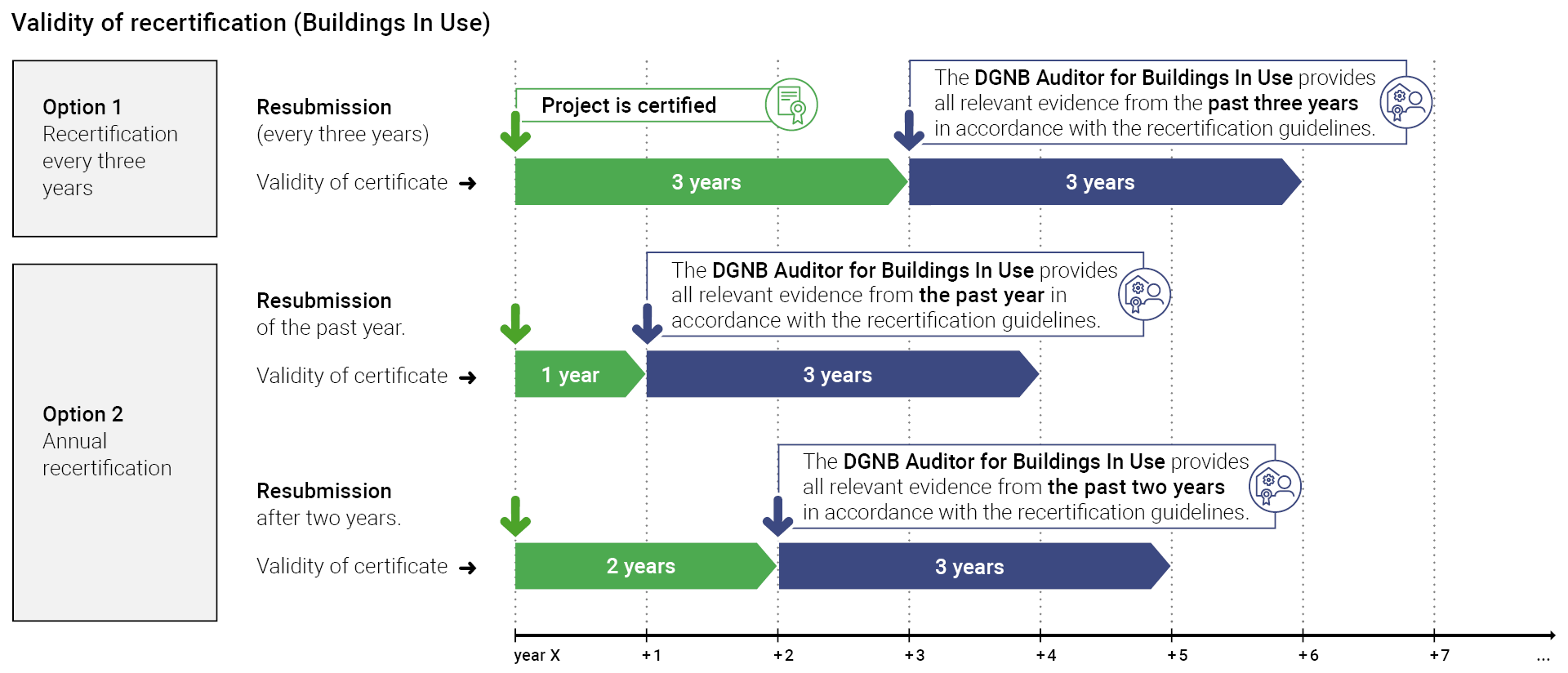
Recertification is possible annually or at least every three years. The requirements can be found in the recertification guidelines, which are included as an appendix in the criteria set.
The fee for recertification (per year) can be found in our scale of fees. If a building is recertified after one year, a fee is charged once. After two years, the fee is charged twice, and after three years, it is charged three times.
Application for property portfolios
The DGNB System for Buildings In Use is particularly well suited for application to entire property portfolios. It is designed to enable transparent comparison of building performance, thereby supporting structured and targeted management of investment decisions.
The process for applying certification to portfolios is divided into two steps:
- In the first step, a basic certificate is issued, in which all aspects that can be evaluated at a higher level are assessed and documented with evidence. The submitted documents are subjected to a comprehensive conformity check. Subsequently, a requirements specification is drawn up, which defines which project-specific evidence must be submitted for a follow-up certificate.
- In the second step, a full, individual DGNB Certificate is created for each additional property or building that is operated on the basis of the basic-certified portfolio. To this end, all remaining aspects that have not yet been addressed in the basic certificate are assessed in accordance with the specifications. The submitted documents are then subjected to a comprehensive conformity check, whereby the aspects from the basic certificate do not need to be verified or checked again.
The certificate is valid for three years from the date of issue and, similar to the certification of a building, can be recertified by submitting annual consumption data. In addition, all relevant criteria are submitted every three years.
The basic certificate is valid for six years.Renewal of the basic certificate is required in two cases: if the requirement specifications are changed or if the DGNB changes the content of the DGNB System for Buildings In Use. The fees for renewing the basic certificate are to be coordinated with the DGNB depending on the scope of the changes.
Project registration
Projects can be submitted in the current market version ‘DGNB System for Buildings In Use, Version 2026’.
Note
The criteria set in the 2020 version is available for download here. |
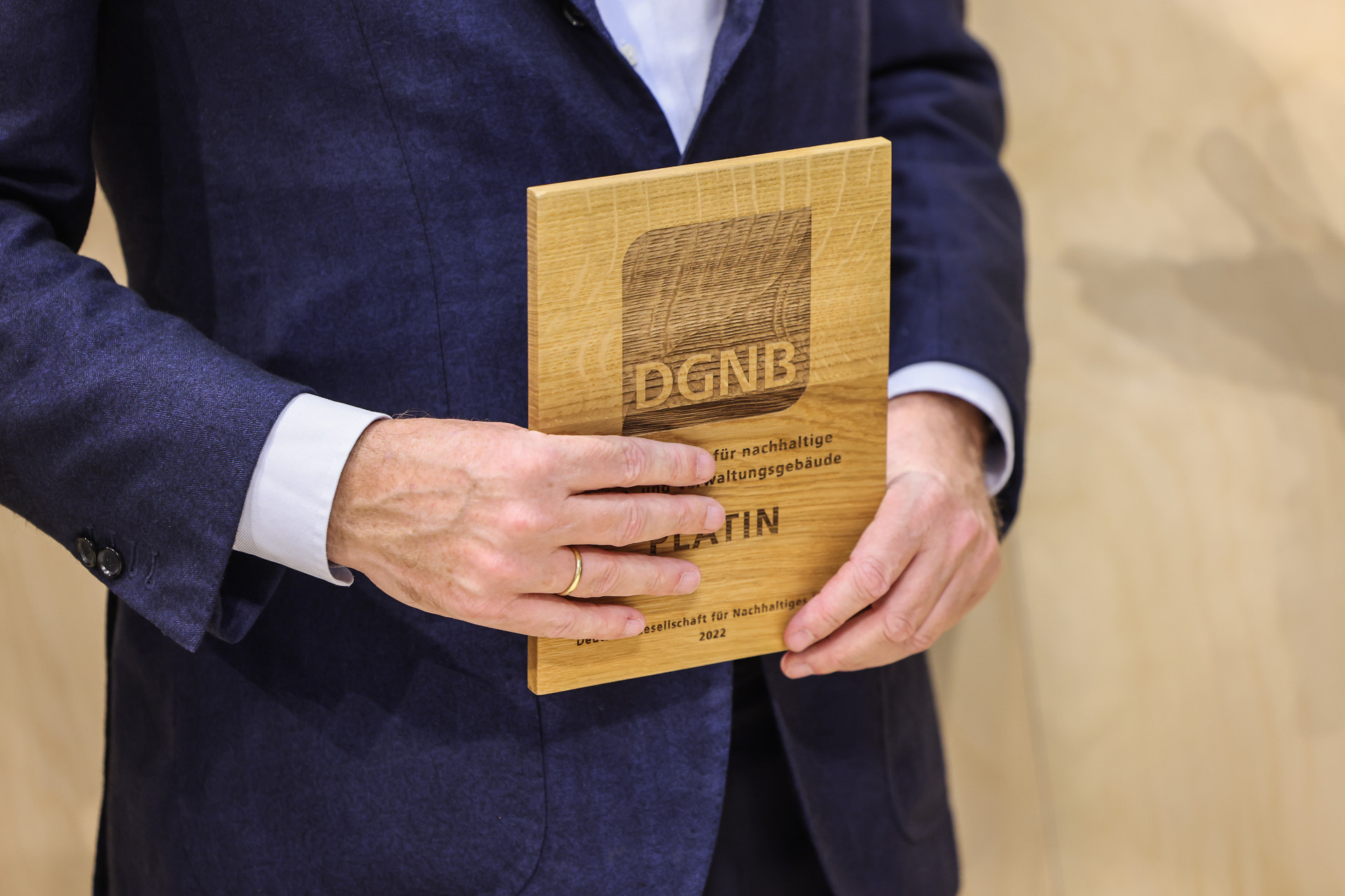
To submit a project for DGNB Certification, contracting parties must first engage a DGNB Auditor for Buildings In Use or a DGNB ESG Manager. This person can submit the project to the DGNB, accompany the entire process, and take care of the documentation and submission to the DGNB.
Selected DGNB-certified projects

Offices and Administriative Buildings

Frequently asked questions about the DGNB System for Building In Use
System version 2026 is an update and further development of the DGNB System for Building In Use, Version 2020. The aim of the revision was to anchor the current requirements of the real estate sector for reporting and the regulatory framework in the new system version and to ensure future-proof real estate.
The new focus of assessments
In addition to tightening a number of requirements, adjustments have been made to how points are distributed within the individual criteria. As a result, greater emphasis is now placed on evaluating actual building performance. Also, more emphasis is now placed on energy efficiency, complementing the existing focus on greenhouse gas emissions. In addition, the characteristics and qualities of existing buildings are now more strongly integrated into assessments.
A completely new focus has been placed on indicators relating to biodiversity. Whereas the previous 2020 version of the DGNB System for Buildings In Use included this topic under the Procurement and Operations criterion, the revised version introduces a dedicated criterion called 'Biodiversity and Rainwater Management' within the Environmental Quality topic area. This aims to promote biodiversity and strengthen on-site natural water cycles.
Compatibility and international relevance
The review process has also focused on compatibility with other rating systems. For example, the update aligns with the requirements of the EU taxonomy. ESG verification offered by the DGNB can continue to be carried out both alongside and independently of Buildings In Use certification. In addition, standards underlying other reporting and assessment initiatives have been used for guidance purposes in developing requirements. These include the Corporate Sustainability Reporting Directive (CSRD), the Sustainable Finance Disclosure Regulation (SFDR), the Global Real Estate Sustainability Benchmark (GRESB), the Energy Performance of Buildings Directive (EPBD), the Carbon Risk Real Estate Monitor (CRREM) and management systems in accordance with ISO 14001 (environmental management) and ISO 50001 (energy management). Information on this can be found in the description of the methods used for the criteria.
By aligning with international standards, the new version of the system can be used throughout Europe. Deviations in methods or validation were made only in exceptional cases to accommodate the requirements of specific countries.
The DGNB System for Buildings In Use is independent of the type of use.
Nevertheless, the main use and, if applicable, the secondary use must be specified when registering a project. The scheme with the largest share of floor space is designated as the primary use. In the case of mixed use, the scheme with the largest share of floor space is designated as the primary use if the share of floor space for the other use is less than 15 per cent. Buildings with an additional use that accounts for 15 per cent or more of the total floor space are classified as mixed use.
An overview of all schemes can be found here.
Yes.
The DGNB System for Buildings In Use is particularly well suited for application to entire property portfolios. It is designed to enable transparent comparison of building performance, thereby supporting structured and targeted management of investment decisions.
The process for applying certification to portfolios is divided into two steps:
- In the first step, a basic certificate is issued, in which all aspects that can be evaluated at a higher level are assessed and documented with evidence. The submitted documents are subjected to a comprehensive conformity check. Subsequently, a requirements specification is drawn up, which defines which project-specific evidence must be submitted for a follow-up certificate.
- In the second step, a full, individual DGNB Certificate is created for each additional property or building that is operated on the basis of the basic-certified portfolio. To this end, all remaining aspects that have not yet been addressed in the basic certificate are assessed in accordance with the specifications. The submitted documents are then subjected to a comprehensive conformity check, whereby the aspects from the basic certificate do not need to be verified or checked again.
The certificate is valid for three years from the date of issue and, similar to the certification of a building, can be recertified by submitting annual consumption data. In addition, all relevant criteria are submitted every three years.
The basic certificate is valid for six years.Renewal of the basic certificate is required in two cases: if the requirement specifications are changed or if the DGNB changes the content of the DGNB System for Buildings In Use. The fees for renewing the basic certificate are to be coordinated with the DGNB depending on the scope of the changes.
The costs for certification can be found in our scale of fees.
Fees for auditor services (or DGNB ESG Managers) are not included in the certification fees. The costs for auditor services are highly dependent on the project. Please discuss these with your DGNB Auditor. Your auditor will also inform you of any additional costs that may be incurred.
With the update of the DGNB System for Buildings In Use 2026 and the revised version of the DGNB Framework for carbon neutral buidlings and sites, an adjustment of the DGNB Award 'Climate Positive' award is also planned. Detailed information on this is expected to be provided in the first half of 2026. If you wish to apply for an award in the meantime, please contact gib@dgnb.de.
Your contact
E-Mail: gib@dgnb.de