
Planning and operating a construction site is a complex process. It requires precise preparation, prudent supervision and high-quality execution from both clients and construction companies. In terms of ecological sustainability, this involves issues such as the use of materials, conservation of resources, transport, the avoidance of pollutants and the preservation of biodiversity. Equally relevant are aspects relating to social responsibility on construction sites. Among other things, the safety of all those involved in the construction process and the implementation of preventive health and safety measures are of paramount importance. At the same time, a successful, smooth construction process often stands or falls with the acceptance of the local community. Information, engagement and dialogue are crucial here.
This is precisely where the DGNB System Sustainable Construction Site comes into play. As a planning and management tool, it helps to strengthen process reliability and minimise risks.
DGNB System for Special Civil Engineering
Do you have a project that falls into the area of special civil engineering? The DGNB has developed a variant of the system specifically for this purpose.
Learn more
The DGNB System Sustainable Construction Site is designed to be applicable to all types of construction site project, and is therefore suitable for all schemes and systems. This includes construction sites for new builds, renovations, deconstructions, and district and infrastructure projects, among others. Special civil engineering projects are an exception, as a dedicated system variant is available for these. The term 'construction site' refers to all work carried out during the construction, repair and/or alteration of buildings. This includes preparatory and finishing work.
The primary target groups for certification are:
- clients
- local authorities
- construction companies
The DGNB System Sustainable Construction Site is aimed at both users in Germany and international stakeholders.
... for building owners
The DGNB System Sustainable Construction Site provides building owners with a valuable guide and action plan to ensure that the construction process runs smoothly and that quality assurance is strengthened during the execution of the works. Obtaining a DGNB Certificate provides transparent evidence of a commitment to greater sustainability on the construction site and can be used in communication with the local community.
- Smoother construction process
- Positive image of the construction site (safe, clean, sustainable)
- Additional quality assurance of the construction work
- Risk minimisation through precautionary concepts
- Demonstrable sustainability
- Positive impact on planned certifications of the district or individual buildings at the site
... for building contractors
This system is particularly well-suited to construction companies that implement company-wide processes across a variety of construction sites. In this case, the system ensures the quality of individual projects and can be seamlessly integrated with existing construction site organisation processes. This is based on the issuance of a basic certification. For all subsequent construction sites, this certification forms the basis of the project-specific evaluation. You benefit in several ways:
- Basic certificate as a unique selling point compared to competitors
- Employee safety
- Systematically optimising existing processes
- Greater attractiveness as an employer for (new) employees
... for local authorities
Local authorities have the option of making DGNB Certification compulsory, thereby contributing to quality assurance at a local level:
- Contribute to achieving municipal sustainability goals
- Higher acceptance of the construction site by the local community
- Smoother construction process
Compatibility
The system is aligned with regulatory requirements such as the EU taxonomy. These are comprehensively incorporated into the criteria set. Where ESG Verification for the EU Taxonomy is sought for a construction project, the system can provide relevant evidence to meet certain requirements.
Finding DGNB experts
Would you like to certify with us?
Have you already decided on a certification and are ready to get started? Here you will find all the certification experts who are qualified to submit projects to the DGNB and can assist with your project.
Find a DGNB Construction Site Coordinator for your project
Would you like to oversee the certification process yourself as an expert? You can find all the information about the DGNB Academy’s training programme here.
The criteria – what constitutes a sustainable construction site?
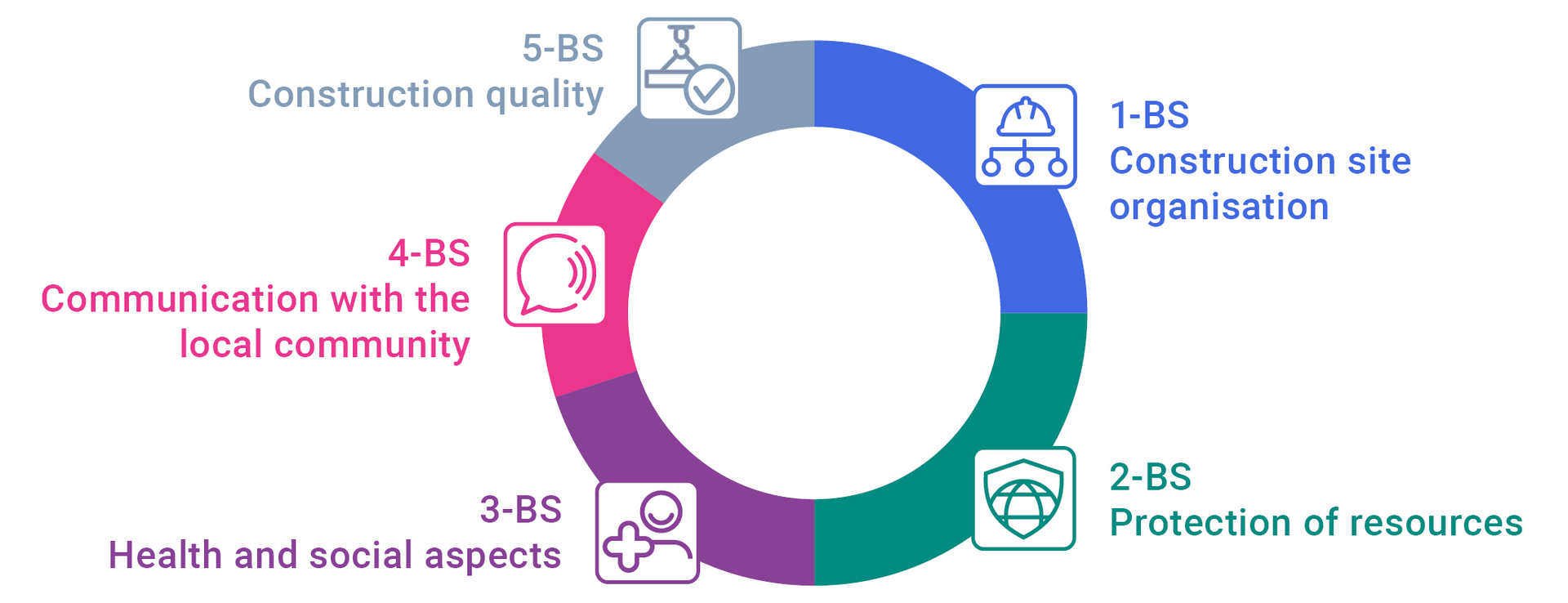
Weighting: 25 per cent
The aim of the criterion is to ensure a smooth and safe construction process in the procurement and construction phases through a well-organised construction site. Furthermore, it is important to minimise the impact on the environment and the consumption of resources during construction, to protect the health of all those involved in construction and to promote social acceptance of the construction project through comprehensive communication with the neighbourhood.
The criterion defines essential specifications for construction site planning and its updating across the various construction phases. Schedules and timetables are required, as well as a health and safety plan. In addition, there are measures to prevent pollution of the local environment. This involves concepts for a low-noise, low-dust and low-waste construction site, soil and groundwater protection, as well as logistics oriented towards the environment and residents.
The criterion of construction site organisation is a minimum requirement for a sustainable construction site.
Weighting: 25 per cent
The objective of this criterion is to systematically record and transparently disclose the environmental impacts of the construction phase. Life-cycle modules A4 (Transport) and A5 (Construction/installation) are assessed to holistically evaluate the resource consumption and emission potential during construction, taking into account recycling and reuse rates. The criterion encourages the environmentally sound execution of construction work and processes by promoting low-emission transport solutions, efficient site procedures, responsible use of construction materials and the application of circular economy principles during construction.
Weighting: 20 per cent
The objective is to safeguard the health and wellbeing of everyone involved in the construction project. Social concerns should be addressed through preventive health measures, information on further training and staff training courses to prevent hazardous situations on the construction site. In order to prevent hazards, a prior assessment of anticipated risks must be carried out, preventive measures must be defined and the implementation of these measures must be monitored.
Another objective is to ensure that internal communication supports these efforts and that information about potential hazards is transparent and freely available. Everyone involved, whether trained or not, should be informed of and made aware of potential hazards to avoid uncertainty in emergency situations.
Furthermore, the aim is to promote health and improve the quality of the working environment through various initiatives.
Weighting: 15 per cent
Public acceptance of construction projects is a key aspect of this criterion. The aim is to proactively inform people before and during construction work and to act as a point of contact.
To ensure targeted communication, the criterion requires an analysis of the affected groups, from which a package of measures is derived.
Weighting: 15 per cent
To achieve planning targets and meet requirements regarding the proper use of construction products, as well as construction supervision and coordination aspects, appropriate quality assurance and comprehensive documentation are essential.
In this context, aspects such as plan management, interface coordination and improvement management are favourably evaluated. The focus is on quality-assuring the construction products used and addressing specific issues such as mould prevention.
DGNB System Criteria Set Sustainable Construction Site, Version 2026
The certification process
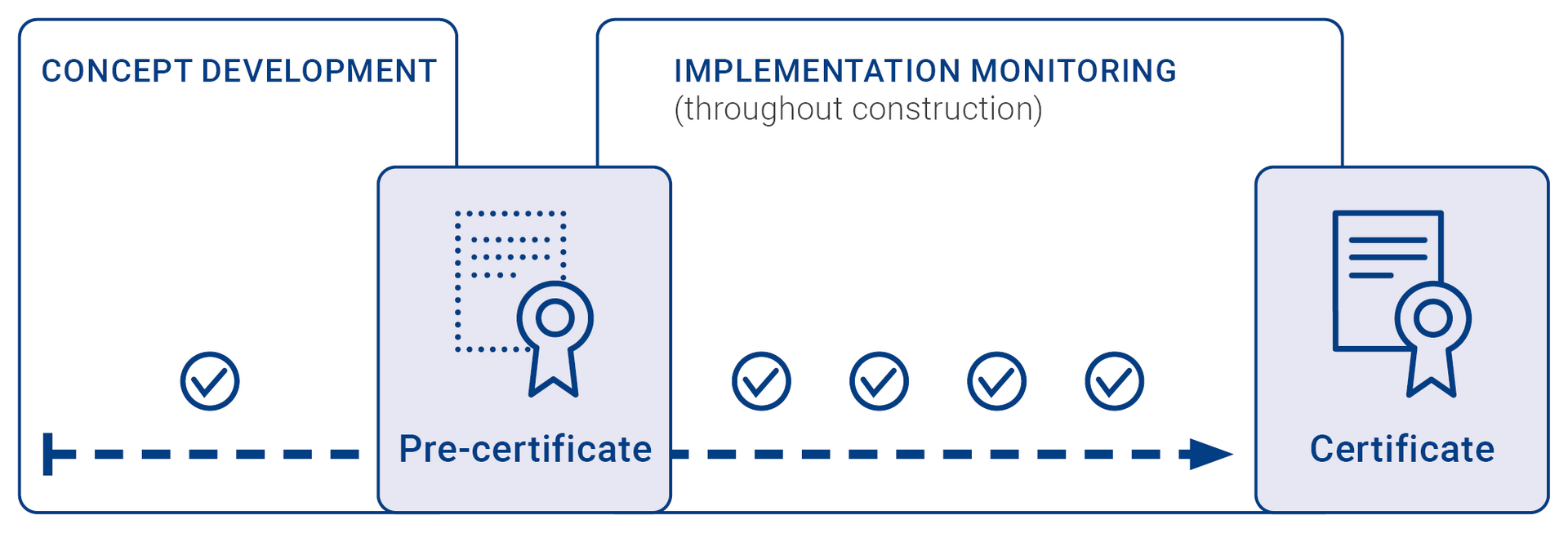
The certification process extends from the planning of the construction site right through to its completion. The plans for meeting the minimum requirements serve as the basis for the evaluation and the award of the pre-certificate. In order to verify sustainability throughout the entire construction phase, supporting documentation must also be submitted at regular intervals during the construction phase. This evidence must be compiled through monthly inspections of the construction site and submitted quarterly from the start of construction. The contracting party will receive the final DGNB Certificate upon successful completion of the construction project.
Registration takes place via the DGNB System Software. A licensed DGNB Construction Site Coordinator is responsible for this, as well as for submitting the documentation required for certification. The DGNB Construction Site Coordinator is commissioned by the contracting party.
The DGNB System for Sustainable Construction Sites is particularly well suited for use across multiple construction sites. In this case, the system serves not only to ensure the quality of individual projects, but also as a process standard.
Requirements that apply to all construction sites to be certified are submitted and assessed once. This means they no longer need to be verified for subsequent projects. This reduces the administrative burden of providing evidence and speeds up the assessment process. Note: This applies only to requirements that can be applied across all construction sites. Indicators that are site-specific must still be verified individually. Furthermore, even where a basic certificate is held, the implementation of the planned measures is reviewed at regular intervals.
An overview of the basic certification process:
- Registration of the basic certificate via the DGNB System Software as a multiple certification (contracting party)
- Drawing up a certification agreement for the basic certificate (DGNB and contracting party)
- Submission of supporting documentation (DGNB Construction Site Coordinator)
- Conformity assessment (DGNB)
- Issuance of the basic certificate (DGNB)
- Preparation of the DGNB requirements specification
- Conclusion of a framework agreement (DGNB and contracting party)
- Registration of follow-up projects
| DGNB members* | Non-members* | |
|---|---|---|
| Registration fee | 1,000 € | 2,500 € |
Building construction
Certification fees for building construction projects are tiered according to the gross floor area and are set as follows:
| Gross floor area in m² | DGNB members* | Non-members* |
|---|---|---|
| < 2,500 | 1,400 € | 2,400 € |
| > 2,500 - 10,000 | 2,000 € | 3,300 € |
| > 10,000 - 20,000 | 2,850 € | 4,450 € |
| > 20,000 - 50,000 | 3,950 € | 5,850 € |
| > 50,.000 - 90,000 | 5,350 € | 7,600 € |
| > 90,000 - 130,000** | 7,100 € | 9,800 € |
Infrastructure
For civil engineering projects, the certification fees are tiered according to the construction cost at the time of application and are set as follows:
| Construction cost at the time of registration in Euro | DGNB members* | Non-members* |
|---|---|---|
| < 2.000.000 | 1,400 € | 2,400 € |
| > 2.000.000 -10.000.000 | 2,000 € | 3,300 € |
| > 10.000.000 - 50.000.000 | 2,850 € | 4,450 € |
| > 50.000 - 250.000.000 | 3,950 € | 5,850 € |
| > 250.000.000 - 1.000.000.000 | 5,350 € | 7,600 € |
| > 1.000.000.000 | 7,100 € | 9,800 € |
Basic certification
| DGNB members* | Non-members* | |
|---|---|---|
| Building construction | 20,000 € | 30,000 € |
| Infrastructure | 20,000 € | 30,000 € |
*All prices are plus VAT
** for buildings with a GFA (R) > 130,000m² we will be pleased to provide you with a specific offer.
Evaluation and award
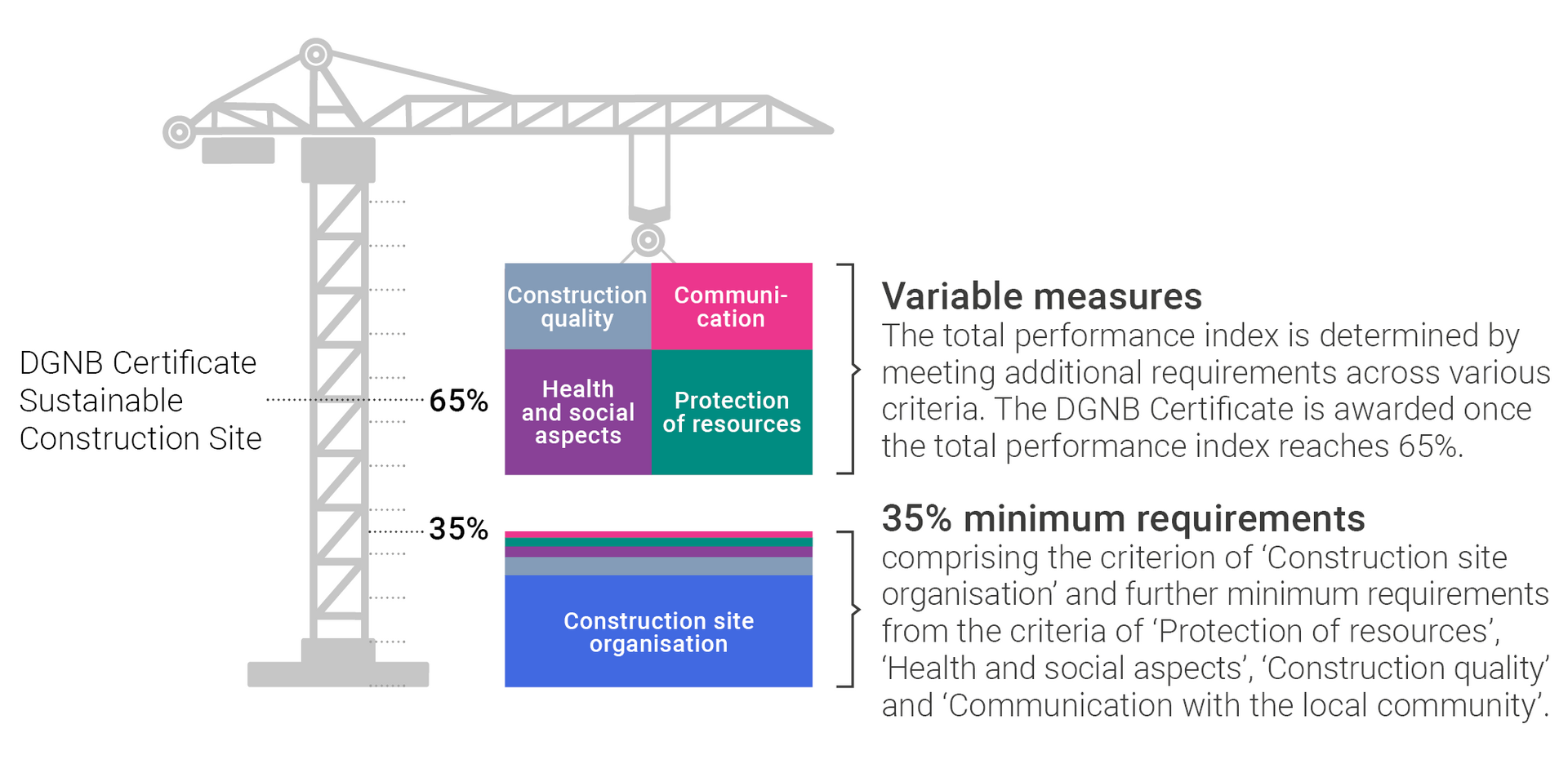
The DGNB System Sustainable Construction Site evaluation is divided into minimum requirements and variable measures. Meeting the mandatory minimum requirements accounts for 35 per cent of the maximum possible points. The remaining points can be achieved through variable measures. The number of points scored in each criterion is not decisive. The DGNB 'Sustainable Construction Site' award is conferred at a total performance index of65 per cent or above. The key to obtaining and retaining the award throughout the construction project is maintaining thorough documentation of the process.
Making commitment visible
Projects that have been awarded a pre-certificate or certificate may use the 'DGNB Sustainable Construction Site' logo in communications relating to the respective construction site. The DGNB also provides construction site banners featuring the organisation's logo.
Selected DGNB-certified projects
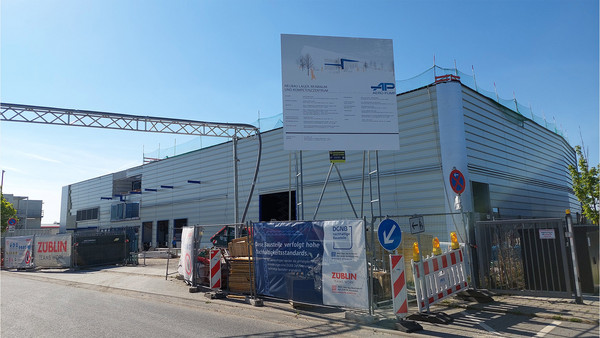
Production Buildings
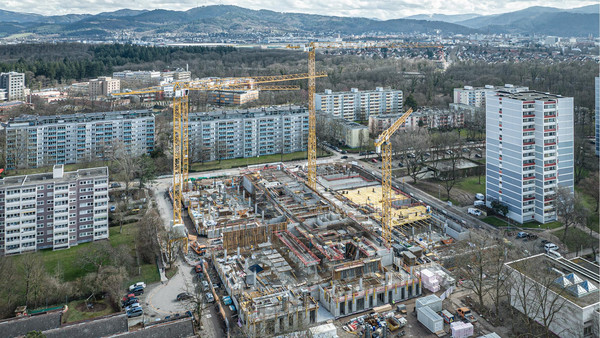
Residential Buildings
Project registration

In order to register a project for DGNB Certification, the contracting parties must first appoint a DGNB Construction Site Coordinator. This person can then register the project with the DGNB, oversee the entire process and compile and submit the supporting documentation to the DGNB.
Frequently Asked Questions
Interoperability and international applicability
During the further development of the DGNB System for sustainable construction sites, synergies with other DGNB Systems were identified in order to reduce the documentation burden where there is overlap in content. These include the DGNB System New Construction, Buildings (Versions 2018 and 2023), the DGNB System Demolition (Version 2020), the DGNB System Renovation of Buildings (Version 2021), the DGNB System Districts (Version 2020) and the DGNB Building Resource Passport.
The construction site itself cannot be designated as taxonomy-compliant within the framework of DGNB Certification. However, if ESG Verification for the EU Taxonomy is sought for the (construction) project, the DGNB Certification System for construction sites can provide evidence for certain EU taxonomy requirements, which have been incorporated into the DGNB Criteria Set. Furthermore, there are synergies with the Sustainable Development Goals (SDGs) and the Level(s) framework.
The systems market version can be applied throughout Europe thanks to the use of international standards. Country-specific particularities regarding methods or evidence are the exception.
Overview of the key changes to the individual criteria
1-BS Construction site organisation
- Specification of requirements/methods, in particular:
- 1.1 An explanatory report on construction site planning
- 1.3 Contents of the construction site setup plan
- 1.4 Minimum scope of site regulations
- 2. Measures to avoid harming the local environment due to the construction site
- New indicator: 1.2 Impacts between the construction site and the environment
2-BS Protection of resources
- Life cycle assessment for modules A4 (Transport) and A5 (Construction/installation)
- Greater focus on CO2-reducing measures in the context of transport and construction
- Integration of the EU taxonomy requirements for the circular economy
3-BS Health and social aspects
- Removal of indicator 3.1.1: Investigations and measures in response to specific circumstances/a pandemic
- Specific examples of preventive measures, health-promoting and social measures
- Specific guidelines on risk assessment and documentation
- New indicators:
- 1.4 Workplace quality survey
- 2.2 Documentation of accidents
- 3.5 Ensuring communication on the construction site through interpreters
4-BS Communication with the local community
- Introduction of an analysis of the relevant target groups for the communication strategy
- Summary of the individual indicators from the pilot phase into a list of measures
- Option to select a communication strategy based on the proposed measures
- Distinction between packages of measures based on the scope for action or decision-making
5-BS Construction quality
- Requirements for the digitisation of documents have been defined in a number of indicators
- Specification of requirements/method:
- 1.7 Use of intelligent machine control and automated construction processes
- 2. Quality assurance of construction products used
- 3. Quality assurance planning: Distinguishing between building and industrial construction on the one hand and civil engineering and infrastructure construction on the other
With a DGNB Certificate for sustainable construction sites, you benefit from a reduced administrative burden and from the ability to count assessment points towards further DGNB Certifications, such as new construction of buildings and districts, renovation and deconstruction. All relevant information can be found in Annex 1 of the system basics of the DGNB Criteria Set.
If you are seeking ESG Verification for the EU Taxonomy for the (construction) project, the system can provide relevant evidence for certain requirements. There are also synergies with the EU Level(s) framework and the United Nations Sustainable Development Goals (SDGs). The requirements from the EU taxonomy that can be demonstrated via the construction site, as well as existing synergies with Level(s) and the SDGs, are set out in Appendix 2 of the system basics.
The construction site itself is not designated as taxonomy-compliant within the scope of the certification.
As a rule, the construction site must be registered before work begins and a pre-certificate must first be issued. However, it is possible to submit a project-specific request for certifiability (PCQ) to baustelle@dgnb.de, which will then be assessed. The decision is made on a case-by-case basis.
For indicators where compliance with the required measures can be demonstrated throughout the entire construction process (e.g. noticeboards, waste containers, tidiness and cleanliness, water consumption monitoring, …), regular monthly documentation must be carried out as part of site inspections.
For indicators evaluating a temporary condition or process (e.g. delivery and installation of prefabricated building components, health-promoting work equipment, etc.), one-off documentation is sufficient.
In such cases, please provide a justification explaining why an indicator representing a minimum requirement is not applicable to the construction project. The DGNB will review the justification and provide an opinion. If the justification is deemed reasonable, the indicator will be considered as having been met. This will not disadvantage you in the overall assessment.