
Designed to be constructed, used and then dismantled again in the space of just a few days, trade fair stands are temporary structures by their very nature. At the same time, this short period gives rise to significant environmental impact. It is therefore worth taking a closer look at how these stands are planned. A structure erected for a trade fair lasting just a few days shouldn't automatically involve high resource consumption, costly custom solutions or large quantities of waste.
For several years now, we at the DGNB have been putting the challenge ‘sustainable exhibition stand’ into practice at our own trade fair appearances, and we can rightly say: it works – provided you act early and with purpose.
The certification system for sustainable trade fair stands, developed in collaboration with representatives from the trade fair industry, supports exhibiting companies, stand builders and other stakeholders in integrating sustainability into the planning and implementation of exhibition stands at an early stage and in a holistic manner. The criteria promote the resource-efficient use of materials, the reuse of components, and the reduction of emissions, alongside consideration of social and functional qualities. At the same time, they support a high-quality visitor experience, good usability and the transparent communication of sustainability aspects.
- Reduced environmental impact
- Simpler organisation, quicker set-up and better documentation
- Reduced procurement effort for future trade fair appearances through the use of reusable or loaned elements
- Opportunity to reduce transport, packaging and last-minute deliveries through early-coordinated logistics
- Conveying our values through sustainable stand design
- Guidance for improved processes, traceable decisions and communication with visitors, partners and internal teams that is grounded in concrete decisions
The award will initially be launched as part of a pilot phase for trade fair stands at BAU 2027, with plans to extend the certification to other trade fairs in the future. We will publish further information on this in due course.
Quick links: Certification criteria | Requirements, application and award | 5 steps to successful certification | Project registration | FAQ
Would you like to get an overview of sustainable trade fair stand design?
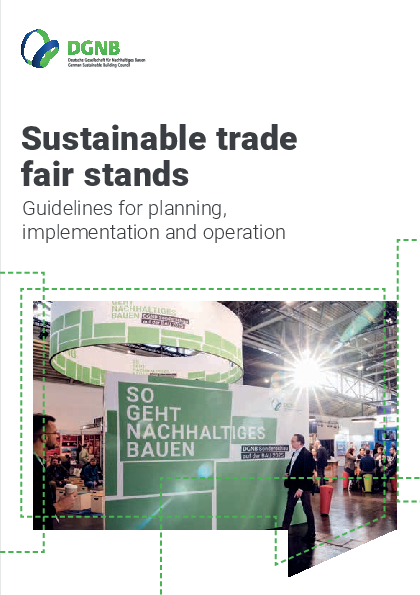
Sustainable trade fair stands: Guidelines for planning, implementation and operation
Certification criteria
The DGNB System for Sustainable Trade Fair Stands considers the key sustainability aspects of a trade fair stand throughout its entire life cycle, from design to use and dismantling. The evaluation is based on three criteria. These reflect the key action areas for sustainable trade fair stands and are factored into the overall evaluation with varying weightings:
- Stand design and communication: 20 per cent
- Material and resources: 45 per cent
- Mobility and logistics: 35 per cent
The focus is on the 'Material and resources' criterium, as this is where the greatest potential lies for reducing resource consumption and environmental impact. The ‘Mobility and logistics’ and ‘Stand design and communication’ criteria complement the evaluation by addressing additional relevant aspects of a sustainable trade fair presence.
Indicators
| 1.1 Barrier-free design | The trade fair stand is accessable and offers sufficient space for movement. |
|---|---|
| 1.2 Orientation | Signage and information resources are clear, easy to find and designed to be inclusive. |
| 1.3 Dwell | The stand provides suitable areas for spending time in and exchanging ideas. |
| 1.4 Interaction | The function of the trade fair stand is immediately apparent and facilitates various forms of interaction. |
| 1.5 Reduction | The design and content are clearly structured and focused on the essentials. |
| 1.6 Transparency | Sustainability aspects of the stand are presented in a comprehensible way for visitors. |
| 1.7 Knowledge sharing | The trade fair team is informed about the sustainable measures implemented at the stand and able to explain these clearly. |
Indicators
2.1 Circularity | Wherever possible, materials, building components and equipment are reused, loaned out or repurposed after their initial use. |
|---|---|
| 2.2 Disassembly | The stand is modular and is designed for non-destructive disassembly. |
| 2.3 Sustainable supply chains | Materials, building components and equipment are sourced from sustainable supply chains and contain secondary raw materials or recycled content. |
| 2.4 Eco-sufficiency | The use of materials is tailored to requirements and kept to a minimum. |
| 2.5 Pollutants | Products with low pollutant and emission levels that are suitable for indoor use are used. |
| 2.6 Waste prevention | Single-use materials and short-term solutions are avoided wherever possible, and waste prevention is taken into account throughout all stages. |
| 2.7 Technical equipment | Technical equipment is planned to conserve resources, operated energy-efficiently and, where possible, reused or loaned. |
| 2.8 Documentation | The materials and building components used are documented, taking climate impact into account. |
| 2.9 Bonus: Carbon footprint | The greenhouse gas emissions of the key materials and components used are calculated. |
Indicators
| 3.1 Travel to and from the venue | Staff travel is planned with consideration for its emissions impact. |
|---|---|
| 3.2 Transport and logistics | Transport and logistics plans for stand materials and equipment are designed to maximise efficiency and reduce emissions. |
| 3.3 Packaging | Transport volumes and packaging are reduced to what is necessary. |
| 3.4 Regional service provision | Where possible, preference is given to local service providers and stand builders. |
| 3.5 Infrastructure | Where possible, existing infrastructure and services at the venue are used. |
DGNB Criteria Set Sustainable Trade Fair Stands, Version 2026
Requirements, application and award
Requirements for certification
- The applicable legal requirements and the specifications of the relevant trade fair organisers must be met.
- Evidence and calculations must relate to the trade fair stand being certified. Where documents relating to a previous planning status are used, their continued validity must be plausibly demonstrated.
Application
The DGNB System for Sustainable Trade Fair Stands can be applied to temporary trade fair stands of various sizes and uses. The assessment covers the trade fair stand itself, including its construction, fittings, equipment and technical facilities, as well as the design, use and dismantling processes directly associated with it. Requirements extending beyond the scope of the trade fair stand are only taken into account where this is specified in the relevant criteria.
Evaluation and award
A maximum of 100 evaluation points can be awarded for each criterion. The total number of evaluation points per criterion is calculated by adding together the specified evaluation points for each indicator. Depending on the extent to which the requirements of the indicator are met, the score achieved for the criterion is included in the overall evaluation. To receive the DGNB ‘Sustainable Trade Fair Stand’ award, a total performance index of at least 50 per cent must be achieved. There are no minimum requirements to be met in individual criteria or topics.
Please note: The award applies exclusively to the submitted trade fair stand as documented and to the respective trade fair event. Changes to the trade fair stand concept, site or general conditions may affect the evaluation and must be reported to the DGNB. A new evaluation is generally required for further trade fair appearances.
5 steps to successful certification of your trade fair stand
1. Project registration
Projects must be registered for certification via the DGNB's online platform, the DGNB System Software. The criteria set, which outlines the measures to be implemented, is also available there.
Please note: The project name entered in the DGNB System Software will appear on the certificate if the project receives an award.
2. Uploading required documentation
The required documentation is compiled based on the design, and then uploaded. It demonstrates which requirements of the criteria set are met and how implementation is planned.
3. Review by the DGNB
The DGNB reviews and evaluates the submitted documentation, verifying whether the requirements of the criteria set have been met.
4. On-site implementation check
On the day before the opening, the trade fair stand's implementation is checked on a random-sample basis. This confirms whether the information submitted matches what is found on site. The spot checks serve as quality assurance and support the traceability of the certification.
5. Receive the award
Following a successful assessment, exhibitors receive a DGNB award on the day before the opening of the respective trade fair. This confirms successful certification and may be displayed at the stand and used in communication relating to the trade fair presence.
Registration and submission are carried out by the relevant project managers. These may include, for example, exhibiting companies, stand-building companies or other organisations commissioned with the design and implementation of the trade fair stand. The involvement of a DGNB Auditor is not required.
Project registration: Upcoming trade fairs
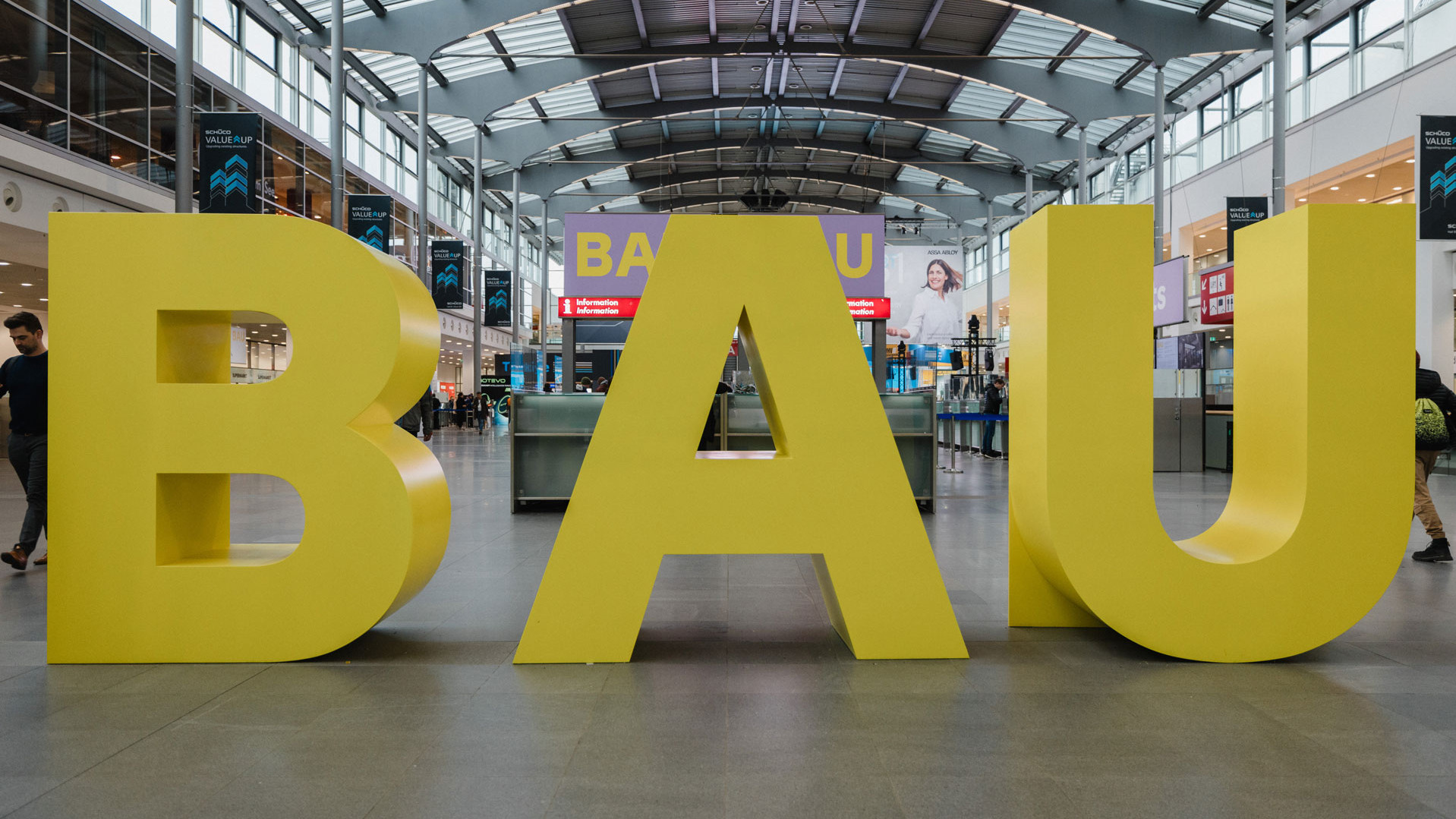
BAU 2027
11 to 15 January 2027, Munich
- Submission deadline:
Submissions to the DGNB must be made by 29 November 2026. - Certification fees:
As part of the pilot project at BAU 2027, the certification fees are set at a flat rate regardless of stand size: € 325 plus VAT.
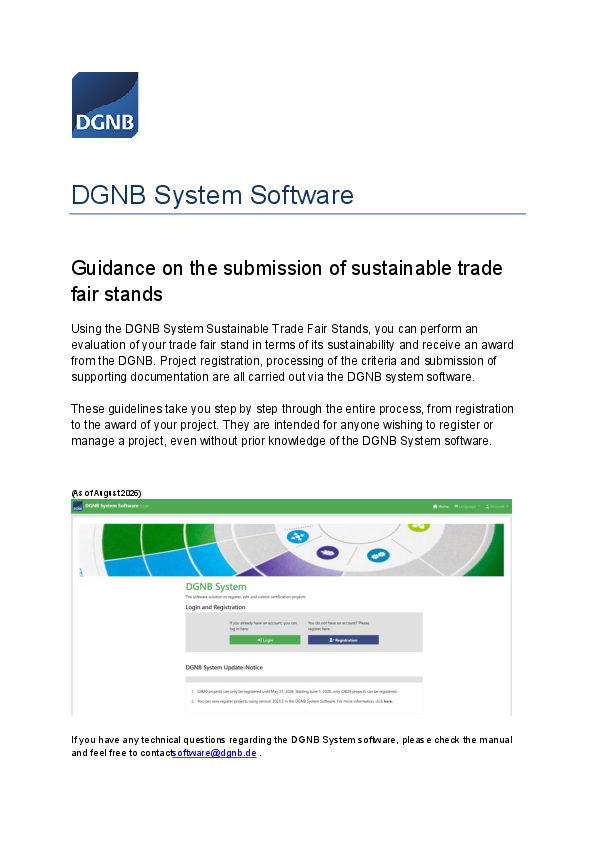
DGNB System Software | Guidance on the submission of sustainable trade fair stands
Frequently Asked Questions
The amount of work involved depends on the size and complexity of the trade fair stand, as well as the extent of the documentation already available. Since much of the information is already available as part of the stand planning process, a large proportion of the required evidence can be compiled from existing documentation. Familiarising yourself with the criteria at an early stage makes the submission process easier and reduces the amount of work involved.