
Against the backdrop of mounting environmental pressures, the design, construction and operation of buildings can no longer focus exclusively on aesthetic, technical and economic aspects. To ensure that our buildings are environmentally sustainable, we must take further factors into account. These include energy consumption, air, water and soil emissions, waste generation and the consumption of raw materials.
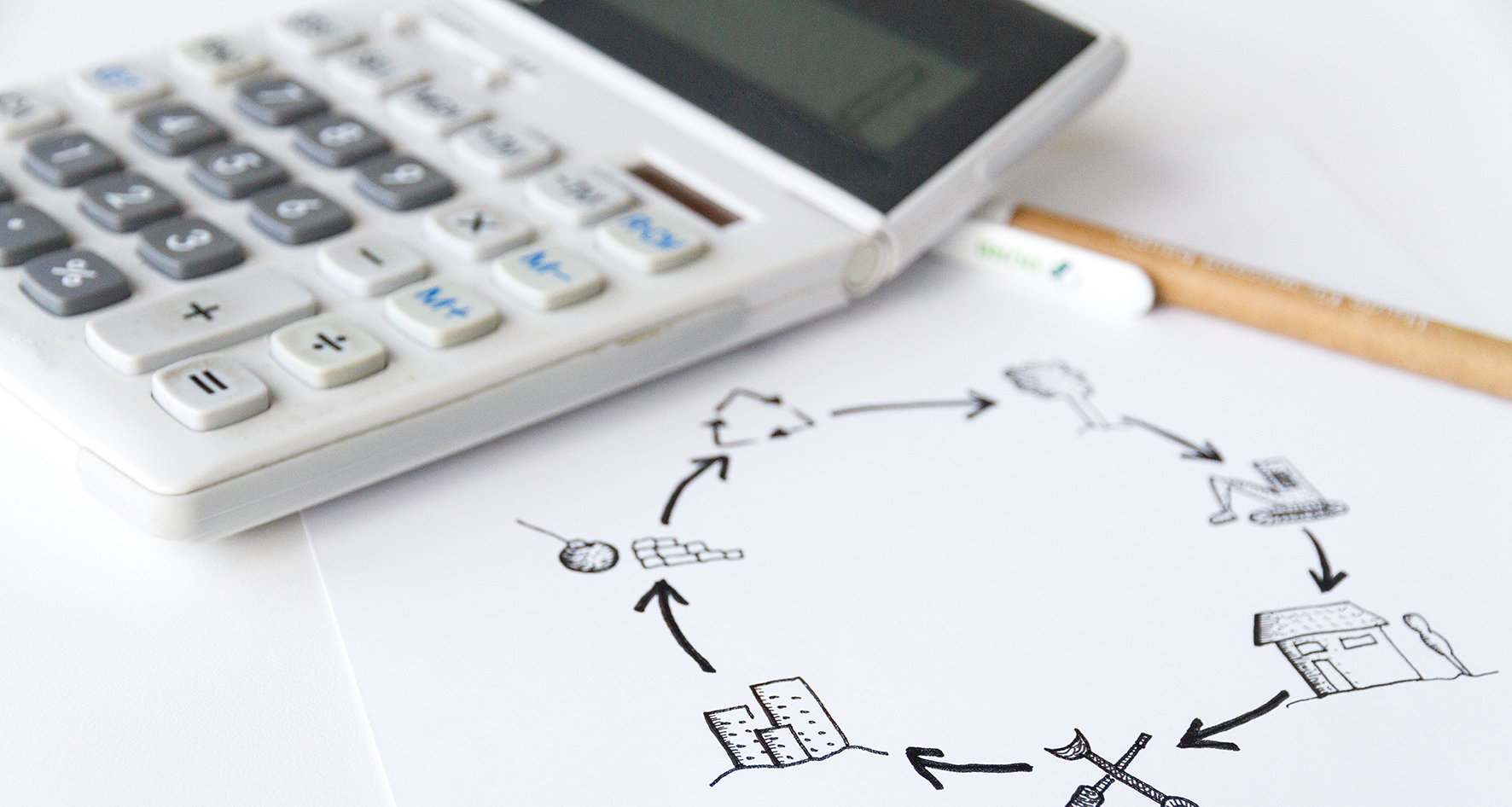
To make reliable assessments and optimise buildings accordingly, it is essential to analyse the entire life cycle of construction works, including the construction materials used, and incorporate the results into the design process. This must include raw material extraction and processing, use and repair, as well as recycling or disposal. The outcome of this analysis is a comprehensive evaluation of all the materials and energy required for the construction, operation, repair and disposal of a building throughout its entire life cycle.
This method is known as life cycle assessment (LCA). LCAs can be carried out for products, services, buildings or other definable systems, and the method enables the properties analysed to be compared using key metrics. Life cycle assessment represents a scientific and standardised method for evaluating the environmental footprint of a given property. It serves to process data and promote transparency in relation to environmental sustainability, thereby acting as a tool for decision-making. LCAs can be applied to almost anything. Those compiling a life cycle assessment must therefore work in an interdisciplinary manner and be capable of developing an understanding of a wide range of materials and processes.
Basics of life cycle assessment
Under the new Buildings Modernisation Act (Gebäudemodernisierungsgesetz, GModG), the disclosure of life cycle assessments is gradually becoming mandatory in Germany. These assessments are based on the DIN EN ISO 14040 and DIN EN ISO 14044 standards. In the construction sector, the relevant standards are DIN EN 15978 for buildings and DIN EN 15804 for construction products and services. These standards provide general definitions and procedures for life cycle assessments. Finally, DIN SPEC 91606 sets out the specific rules for building life cycle assessments in Germany. A life cycle assessment evaluates various environmental impact categories, such as global warming potential, acidification potential and eutrophication potential, all of which are specified by the standards.
Data source
For construction products and services such as heat or electricity generation, the Federal Ministry for Housing, Urban Development and Building (BMWSB) provides a free database containing life cycle assessment data sets (ökobaudat.de). Manufacturers are increasingly making product-specific life cycle assessment data available in the form of independently verified Type 3 EPDs (Environmental Product Declarations). EPDs provide life cycle assessment information on construction products in a standardised, transparent format. EPDs must be validated by an independent programme operator. In Germany, this is most commonly carried out by the Institut für Bauen und Umwelt e.V. (IBU).
How to conduct a life cycle assessment – an overview
Conducting a life cycle assessment involves several steps. First, the goal, the assessment scope and the environmental impacts to be taken into account must be defined. Based on this, an inventory analysis and an impact assessment are carried out. Finally, the results are summarised in a report and interpreted.
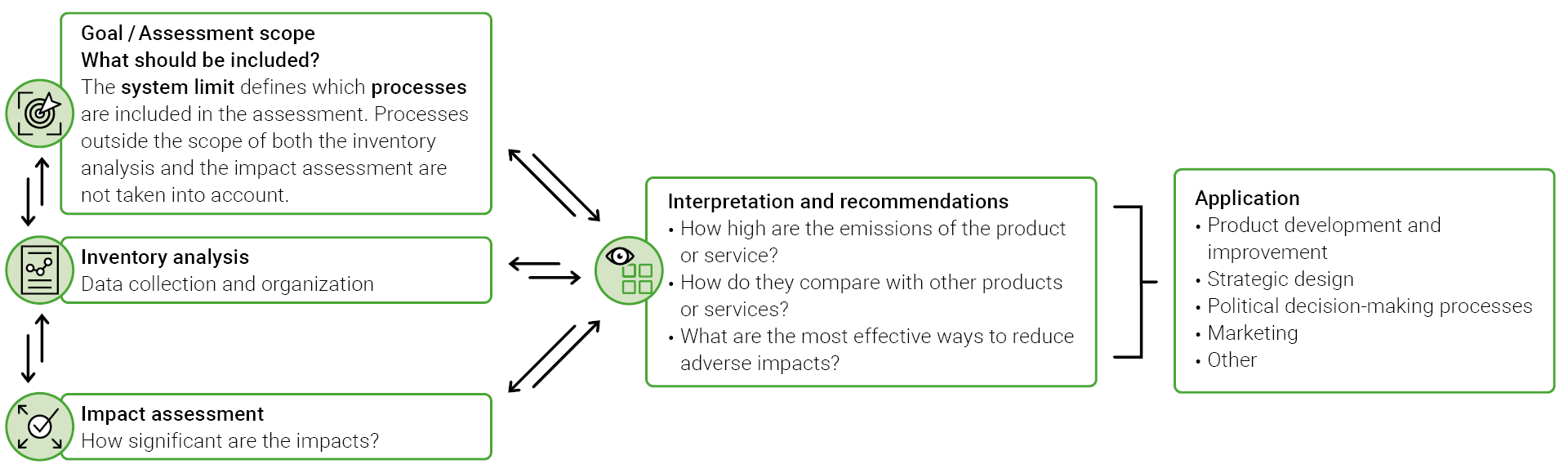
Conducting a life cycle assessment can serve various goals. Depending on the goal, the level of detail and the data used may vary. It is therefore important to first establish what goals the life cycle assessment is intended to achieve. These may include, for example:
- Identification of environmental hotspots
- Optimisation in the design or planning process
- Environmental product comparison
- Preparation of an EPD / conducting a building life cycle assessment
- Reporting
Firstly, the scope of the assessment determines what will be analysed. Is the focus on a building component, a process, a construction product, a building, how a building is operated, or an entire district? Alongside the assessment scope, the system limit determines whether the entire life cycle or only part of it is considered.
- Cradle to Gate: Describes the life cycle assessment for the life cycle stages raw material extraction and manufacturing.
- Gate to Gate: Describes the life cycle assessment for the life cycle stage manufacturing.
- Cradle to Grave: Describes the life cycle assessment for the life cycle stages raw material extraction, manufacturing, use and end of life.
- Cradle to Cradle: Describes the life cycle assessment for the life cycle phases from Cradle to Grave and takes into account potential impacts and credits outside the system limit.
Once the life cycle to be assessed has been defined, the next step is to determine the assessment period. This depends on the type of property and its service life. A service life of 50 years is assumed for buildings, while interior fittings typically have a service life of five to ten years.
The next step is to determine which environmental impacts – and therefore which measurement indicators, also known as impact categories – are to be included in the assessment. The DIN EN 15978 standard defines specific impact categories. In the certification process, global warming potential is the dominant factor. However, other impact categories, such as eutrophication potential and acidification potential, are also taken into account.
Once the scope has been defined, the inventory analysis records the quantities of the various substances, materials and energy consumption required for the manufacture, use and disposal or recycling of the product or building. Suitable environmental data (emission factors) are then assigned to the recorded material quantities and processes in the inventory analysis.
The impact assessment calculates the total environmental impact over the defined service life. The construction method and type of materials used, as well as their replacement frequency, determine how high or low these environmental impacts are. A building life cycle assessment accounts for the impacts of raw material extraction and the production of building materials, as well as the material and energy consumption associated with construction, maintenance and the operation of the building. Disposal and the potential for material recovery at the end of the life cycle are also considered.
In the interpretation of the results, key parameters that influence the life cycle assessment outcome are identified (e.g. individual life cycle stages or impact categories). This is followed by a consistency check, a completeness check and a sensitivity analysis. Conclusions and recommendations are then developed from the results and compiled into a report.
This report can, for example, help inform the decision of whether a building or building component should be retained, demolished or newly built. It also provides information on which construction method is the most environmentally friendly for a new-build project. By comparing different design options and optimising the preferred option, environmental impacts can be reduced.
When to use life cycle assessments
Life cycle assessment can offer significant added value as a decision-support tool, particularly in the early planning phases, when changes can be implemented with little effort and fundamental decisions are made.
The first step should be to check whether new construction can potentially be replaced by a renovation, thereby avoiding additional resource use (service phase 0 – needs assessment (according to the German Fee Structure for Architects and Engineers (HOAI)). If new construction is to be constructed, HOAI service phases 1 to 3 offer the greatest potential for the implementation of changes and optimisation decisions during the planning process. At the same time, these changes can be implemented at an early stage at significantly lower cost and with less time expenditure.
In general, it is recommended that life cycle assessment be carried out throughout the construction project – from the early planning phase through to the tendering process and any green procurement processes, right up to the completed building.
Key benefits of life cycle assessment:
- Helps to shape transformation by identifying and reinforcing positive impacts on the climate and the environment
- Early implementation enhances the sustainability impact and planning security through targeted optimisation of buildings and building components
- Helps to reduce environmental impacts holistically, rather than simply shifting them from one problem area to the next
- Can reduce costs in the long term and increase the efficiency of the building
- Opens up access to funding and financial incentives
- Strengthens the sustainability image and supports credible communication
- Serves as a documentation tool and ensures compliance with legal requirements (approval for new builds from 2028 / 2030)
Life cycle assessment in the construction industry
The life-cycle approach to buildings in legislation (EU requirements)
The European Union has committed to becoming climate-neutral by 2050. The building sector plays a key role in this. The Energy Performance of Buildings Directive EPBD (EU) 2024/1275 creates the foundation for this. It aims to improve the overall energy efficiency and environmental footprint of buildings, and makes life cycle assessment a mandatory requirement.
From 2028, it will be mandatory for all new public buildings and new buildings over 1,000 m² to disclose life cycle assessments; from 2030, this will apply to all new buildings. In Germany, this requirement is being transposed into national law through the Gebäudemodernisierungsgesetz, GModG (i.e. Building Modernisation Act). This refers to DIN SPEC 91606 as the basis for assessment.
Member states must submit a roadmap by 1 January 2027 defining CO2 limits for new buildings, starting from 2030.

Life cycle assessment software
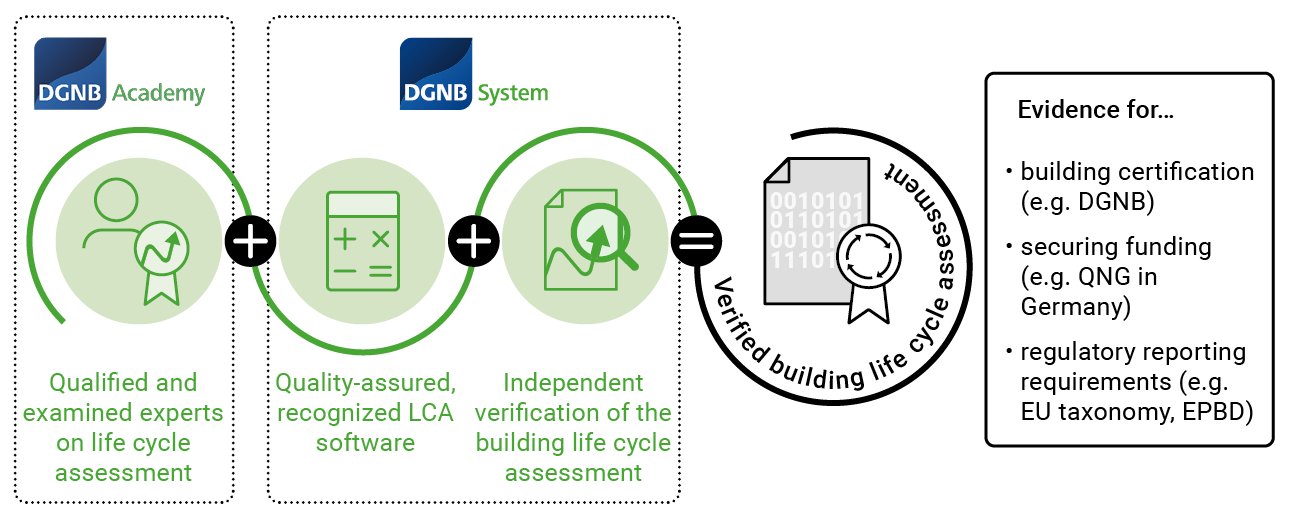
When conducting life cycle assessments, it is very helpful to use quality-assured software. There is an increasing number of such programmes available on the market – each with different features. Which software is best suited to your needs depends on several factors. You can find information on a number of software solutions here (German only):
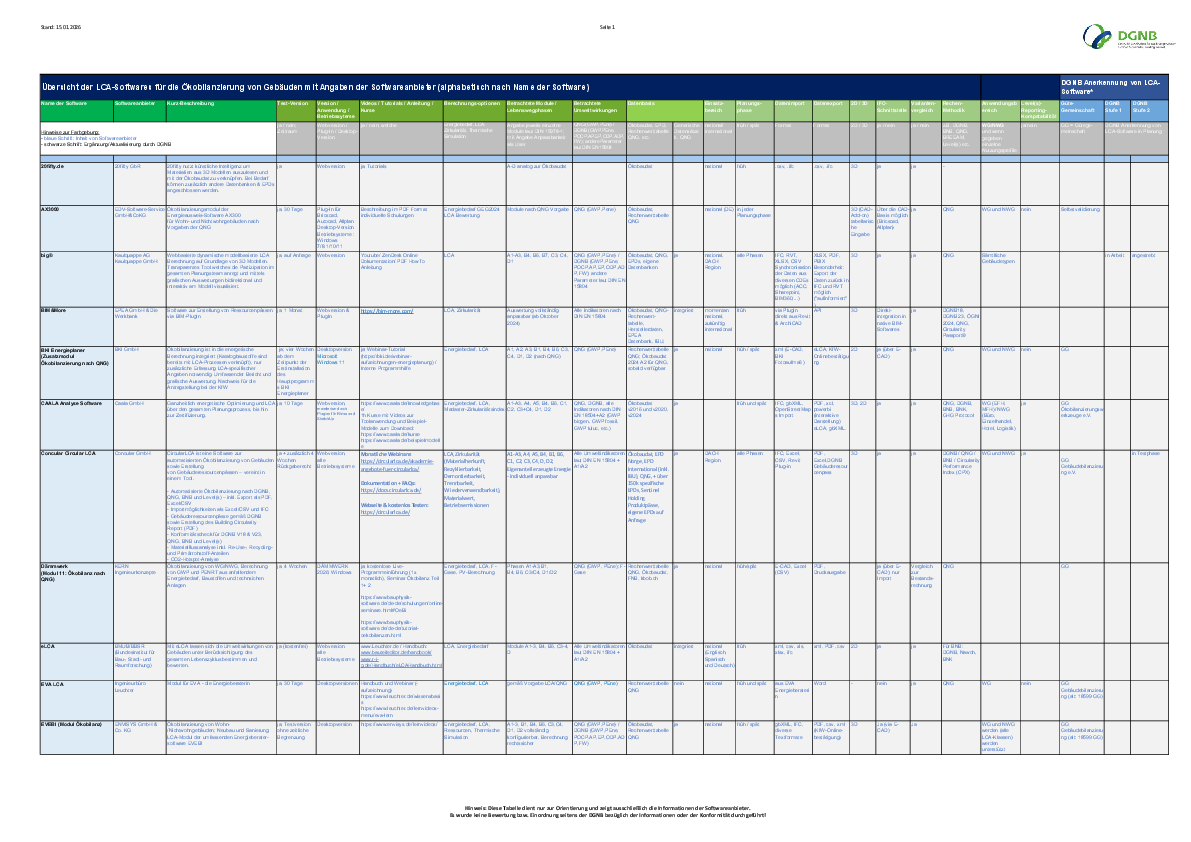
Life cycle assessment software containing data provided by the manufacturers
Relevance of life cycle assessment in the DGNB System
In 2008, the DGNB was one of the first organisations worldwide to define detailed guidelines for calculating life cycle assessments for buildings and to provide benchmarks within its certification system. Life cycle assessment has therefore always been an integral part of DGNB Certification and is incorporated into almost all of its systems. The rules for life cycle assessment modelling can be found in the respective criteria sets. At a higher level, the 'Framework for carbon neutral buildings and sites' serves as a key reference document within the DGNB.
For example, the criterion 'ENV1.1 Climate action and energy' in the DGNB System New Construction, Buildings, Version 2023.2, states: 'Our objective is to consistently design buildings in a life cycle-oriented manner in order to minimise the emission of climate-impacting greenhouse gases, the consumption of energy and material resources, and other impacts on the environment throughout all stages of a building's life'. Life cycle assessments are conducted in virtually all projects and, with an approximate 10 per cent weighting, can be decisive for certification. For buildings that are not yet designed to operate with net-zero greenhouse gas emissions at the time of completion, the preparation of a 'Climate Action Roadmap' is required. Projects aiming for Platinum certification must submit an 'Ambitious Climate Action Roadmap'.
Life cycle assessment as a prerequisite for receiving BEG funding
Whilst life-cycle assessment has always been part of DGNB Certification, it has also been made a mandatory prerequisite under the 'Climate-Friendly New Construction' funding programme run by the Federal Funding Scheme for Efficient Buildings (BEG). A life cycle assessment must be conducted in order for a building owner to be eligible for funding.
MORE ON THE FEDERAL FUNDING PROGRAMME BEG
DGNB publications on life cycle assessment
The DGNB regularly publishes information and studies on life cycle assessment. You can find a selection of key publications here:
Life Cycle Assessment – a guide on using the LCA
DGNB studies on life-cycle assessment and building life-cycle analysis
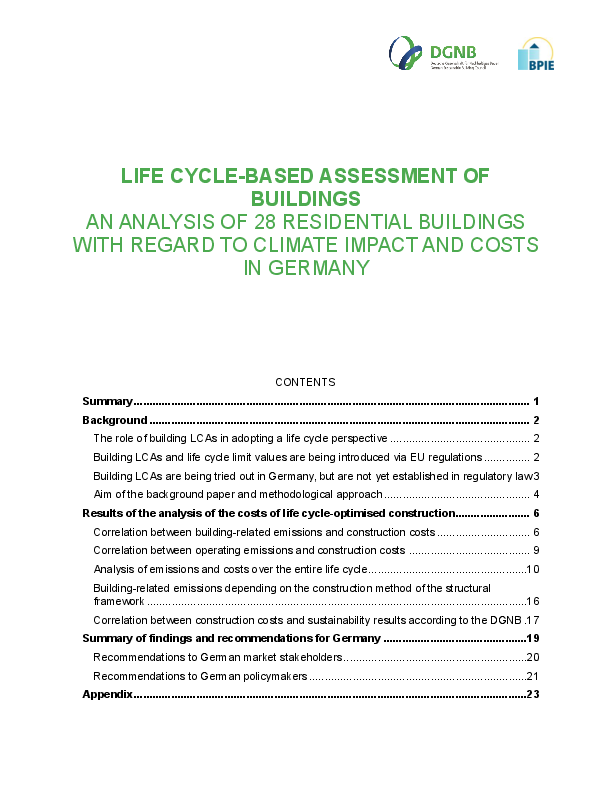
Life cycle-based assessment of buildings an analysis of 28 residential buildings with regard to climate impact and costs in Germany
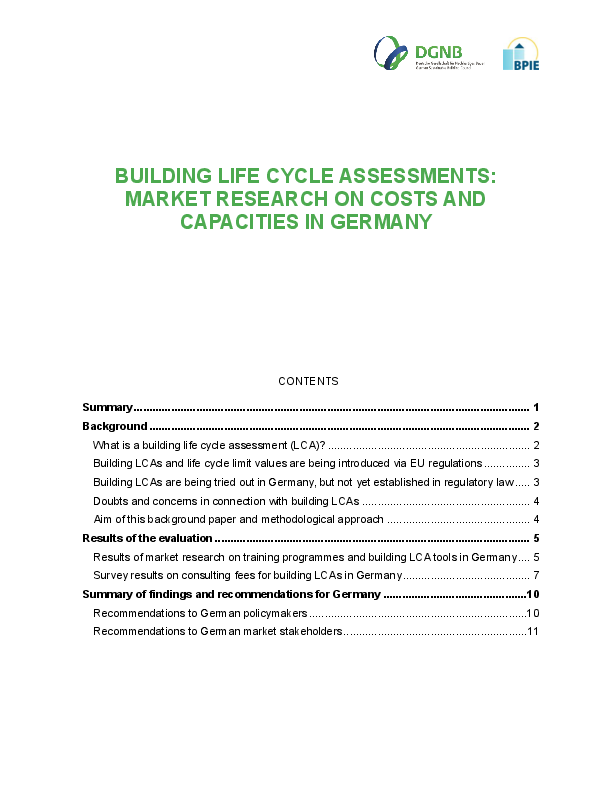
Building life cycle assessments: market research on costs and capacities in Germany
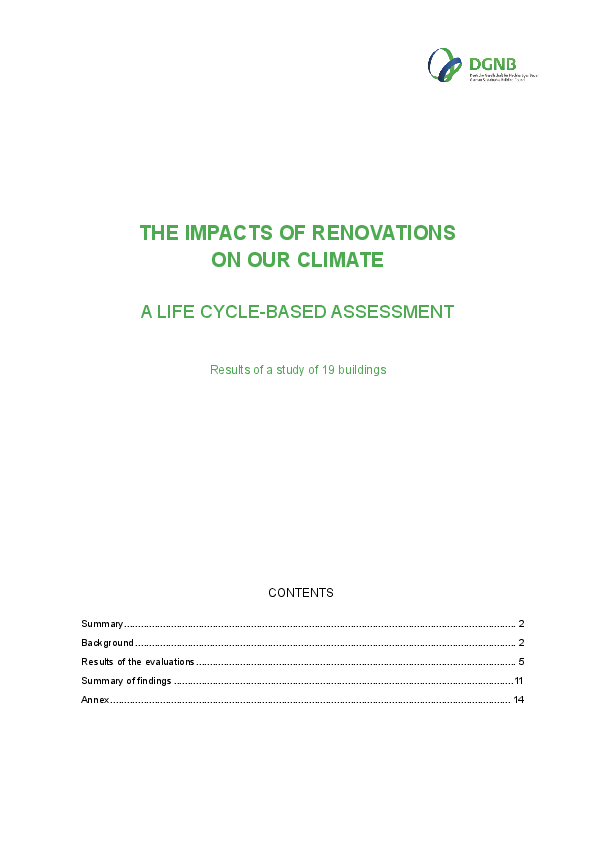
The impacts of renovations on our climate: a life cycle-based assessment

Environmental Product Declarations for construction products: a review of availability, costs and trends in Germany
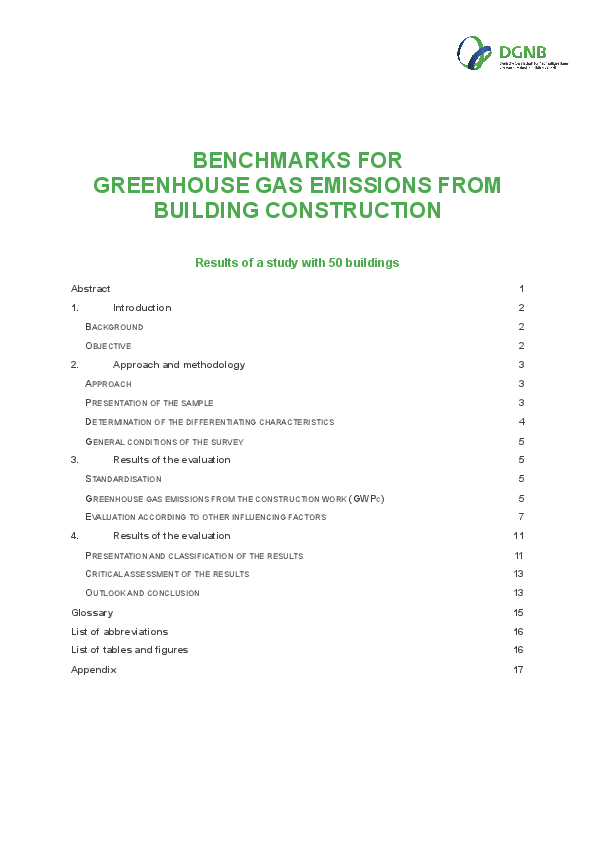
Benchmarks for greenhouse gas emissions from building construction
Your contacts
Julia Weißert
Certification / Life Cycle Assessment
- Phone: +49-711-722322-179
- Email: j.weissert@dgnb.de
Jenny Goldbach
Certification / Buildings in Use / LCA Software Approval
- Phone: +49-711-722322-173
- Email: j.goldbach@dgnb.de