
Districts are a central element of urban design. Whether they are business districts, urban districts, industrial sites or commercial areas, they structure the various functions of everyday urban life. This makes it all the more important to design, maintain and develop them in a sustainable and futureproof way. Existing buildings and districts play a key role here, as their transformation is essential for achieving national, European and global sustainability and climate action targets. This is precisely where the DGNB System for Existing Districts and Renovation, Version 2026 comes in. As a design and optimisation tool, it enables existing districts with and without implemented or planned renovation measures to be evaluated, highlighting potential for transformation.
The certification system is intended to help owners of existing properties, as well as project developers, local authorities (including redevelopment agencies, urban planning and economic development departments) and companies with their own sites, assess the condition of their districts and sites, and assist with their transformation.
The system can be used in the context of a large-scale district transformation and redevelopment, or for assessing an existing district with minor structural and design interventions. The following district types are considered:
- Urban districts (mixed-use districts with at least 10 per cent residential use)
- Business districts (predominantly buildings for services, special uses (e.g. cinemas) and residential-compatible commercial forms; residential share is a maximum of 10 per cent)
- Commercial areas (heterogeneous ownership structure; at least two different types of buildings (e.g. production and office))
- Industrial sites (predominantly industrial sites of a company)
Some banks offer more favourable financing terms for projects that meet ESG criteria. A DGNB Certificate can serve as proof of this.
Additionally, the KfW Programme 432: Energy-Efficient Urban Regeneration (German only website) provides proportionate funding for measures implemented during the certification process. This includes stocktaking of green spaces, an analysis of energy efficiency potential and the cost-effectiveness of investment measures, preparation of an overall energy balance for the district and involvement of relevant stakeholders. However, the certification fees themselves are not eligible for funding under the programme. Please note: As of May 2026, no new applications for the funding programme can be submitted.
Funding for DGNB Certification fees and the DGNB Auditor fees can be applied for as part of the Urban Development Support programme. However, this is decided on a case-by-case basis.
The DGNB cannot guarantee that funding or support will be granted via the aforementioned options.
Quick navigation: Criteria | Award and validity | Project registrationg | FAQ
Criteria
The DGNB System for Existing Districts and Renovations is based on the three central sustainability areas of environmental quality, economic quality and socio-cultural quality. It also takes process quality into account. These topics are weighted as follows:
- Environmental quality: 35 per cent | 4 criteria
- Economic quality: 25 per cent | 4 criteria
- Socio-cultural and functional quality: 25 per cent | 4 criteria
- Process quality: 15 per cent | 3 criteria
The weighting of individual criteria varies depending on whether it is an urban or business district, a commercial area or an industrial site. The specific rules governing this are set out in the criteria set.
Award and validity
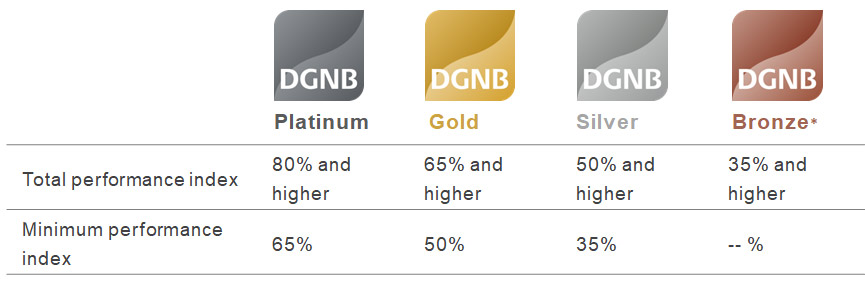
Like other DGNB Systems, the DGNB System for Existing Districts and Renovation evaluates performance indices. The total performance index is calculated based on the evaluation of the individual criteria: a district achieves a DGNB Certificate in Bronze if its total performance index is 35 per cent or higher. Silver is awarded for a total performance index of 50 per cent or more. To receive a DGNB Sustainability Certificate Gold, the project must achieve a total performance index of at least 65 per cent. Platinum is awarded for a total performance index of 80 per cent or more.
Selected DGNB certified projects
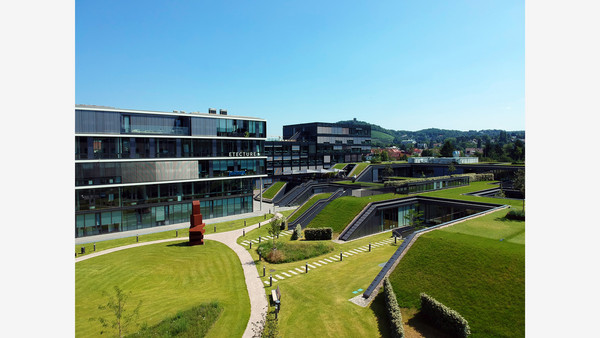

Business Districts
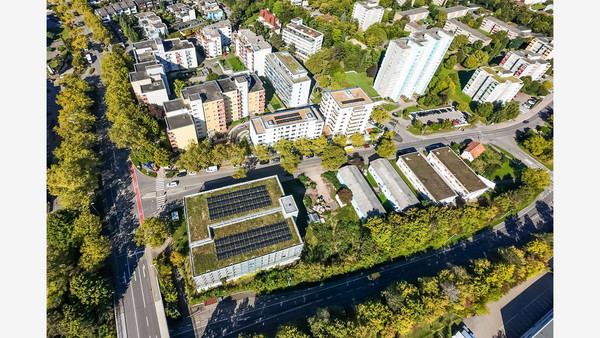
Urban Districts
Project registration
Projects can only be submitted by a DGNB Auditor. During the pilot phase, auditors who have previously focused on buildings (New Construction and Renovation) can also submit applications, in addition to auditors with the additional qualification for districts. Following a successful conformity assessment, they will receive the additional qualification to register district projects. You can find DGNB Auditors for your project here.
![[Translate to English:] Eine Person hält eine Holzplakette in den Händen.](/fileadmin/_processed_/a/f/csm_dgnb-plakette-holz-expo-real_221004_324_b7784f4f62.jpg)
Please note the following regarding registration for the DGNB System for Existing Districts and Renovation: It is expected that projects will be able to be registered and processed in the DGNB System Software from September 2026. Until then, DGNB Auditors can email quartiere@dgnb.de to request the editable registration form. To complete the registration, the completed registration form must be sent to system@dgnb.de with quartiere@dgnb.de in cc. Projects are evaluated using the evaluation matrix, the mastertool and the documentation sheets. These will be sent upon receipt of the project registration and on request.
Costs are based on the DGNB fee schedule for districts and sites.
Frequently Asked Questions
This system variant highlights the importance of districts in the transformation of the building stock, filling a gap in DGNB Certification. During its development, the focus was consistently on future viability, including climate action and adaptation and promoting social cohesion. Heterogeneous ownership structures, data gaps and a wide variety in the condition of the existing built environment made it particularly challenging to develop a collective set of requirements.
During the pilot phase, at least 50 per cent of the total gross floor area must consist of existing buildings at the time of (pre-)certification (including existing buildings, renovations and new construction). Buildings are considered 'existing' if they are more than three years old when submitted for the initial conformity check.
Engagement with the topics and the preparation of baseline and potential analyses should take place as early as possible.
Where district renovation is planned, a pre-certificate can be obtained based on a master plan or development concept. For existing districts where no structural changes are planned and certification is sought, the certification process can be initiated directly.
Points can be awarded for individual indicators of the DGNB System for Existing Districts and Renovation if there are already buildings, traffic areas or open spaces within a district that have a DGNB Certificate. This allows districts to benefit from the qualities of the individual components.
Synergies are also planned in the area of building certification. The aim is for all systems to complement each other. The exact details are still being finalised.
Successful completion of the ‘Planning sustainable and liveable districts’ module entitles participants to receive the additional qualification required for submitting district projects. At the upcoming session on 21 and 22 July 2026 (German only), participants will receive an initial introduction to the new DGNB System for Existing Districts and Renovation. Further information on which modules and training pathways qualify participants to submit projects for existing districts will follow shortly.
No distinction is made between small and large renovation projects. If major structural changes are planned, the ‘renovation’ type is used. If no structural changes are planned and the primary objective is to evaluate the current condition of the district, the ‘existing building’ type is used. Certificate renewal is also possible where further measures are to be implemented.
The 2020 version of the DGNB System for Districts still applies to newly developed districts. The existing system remains unaffected by the new system variant for existing districts. However, the new system variant can be used as part of a DGNB Flex application for new or partially new districts. This can only be done in consultation with the DGNB. For more information, please email us at quartiere@dgnb.de.
During the development of the criteria, we maintained regular communication with our system partners in Denmark, who intend to adapt this version for their market. Other system partners took the opportunity to share their suggestions and requirements with us during our regular exchanges and collective meetings.
Your contacts
Please feel free to send any questions you have to our email address: quartiere@dgnb.de