
What if we weren’t allowed to construct new buildings anymore?
Soil is one of the most valuable and limited resources we have. Knowing this, the following figure seems absurd: according to Germany's Federal Statistical Office, newbuild developments and transport infrastructure consume over 50 hectares of undeveloped land in the country every day. And this despite the government's land strategy of achieving net zero land consumption by 2050. So it's high time that we broke out of established ways of thinking. Whenever we seal our soil, we displace nature, remove habitats and prevent rainwater from seeping away. And once land has been built on, it is rarely unsealed again.
The principle of new construction on greenfield sites has had its day. Instead, we need to think about what more can be done with existing buildings. Transforming structures. Revitalising vacant properties. Not demolishing buildings just because they're more than 30 years old. And sometimes saying: this land will remain unbuilt on. All of these are paradigms that are still far too often the exception rather than the rule. Yet engaging with what's already there needs to become normal. At the moment, many architectural professionals shy away from projects revolving around existing buildings. Spectacular newbuilds are seen as the only way to grab public attention. So we urgently need to internalise and practice a new ideal: transforming existing buildings sensitively and matter-of-factly.
To get there, everyone needs to be on board, from planners and construction professionals to politicians and the wider public. Let's see it as both a privilege and an opportunity to continue something that has already been created! The creative possibilities are different, but varied. Renovation or modernisation, conversion, adding storeys or redensification: the right choice for a particular project depends on both the construction task and the condition of the existing property.
At times this requires a different type of creativity, patience and more discussion. And the architectural quality of the finished project might not be immediately apparent. But is that bad? On the contrary! Because it's also about preserving architectural heritage. And the good feeling of making the right choice rather than the easy one. In other words, it's about a role that architects themselves are only too happy to lay claim to – that of responsibly shaping a built environment that's ready for the world of tomorrow.
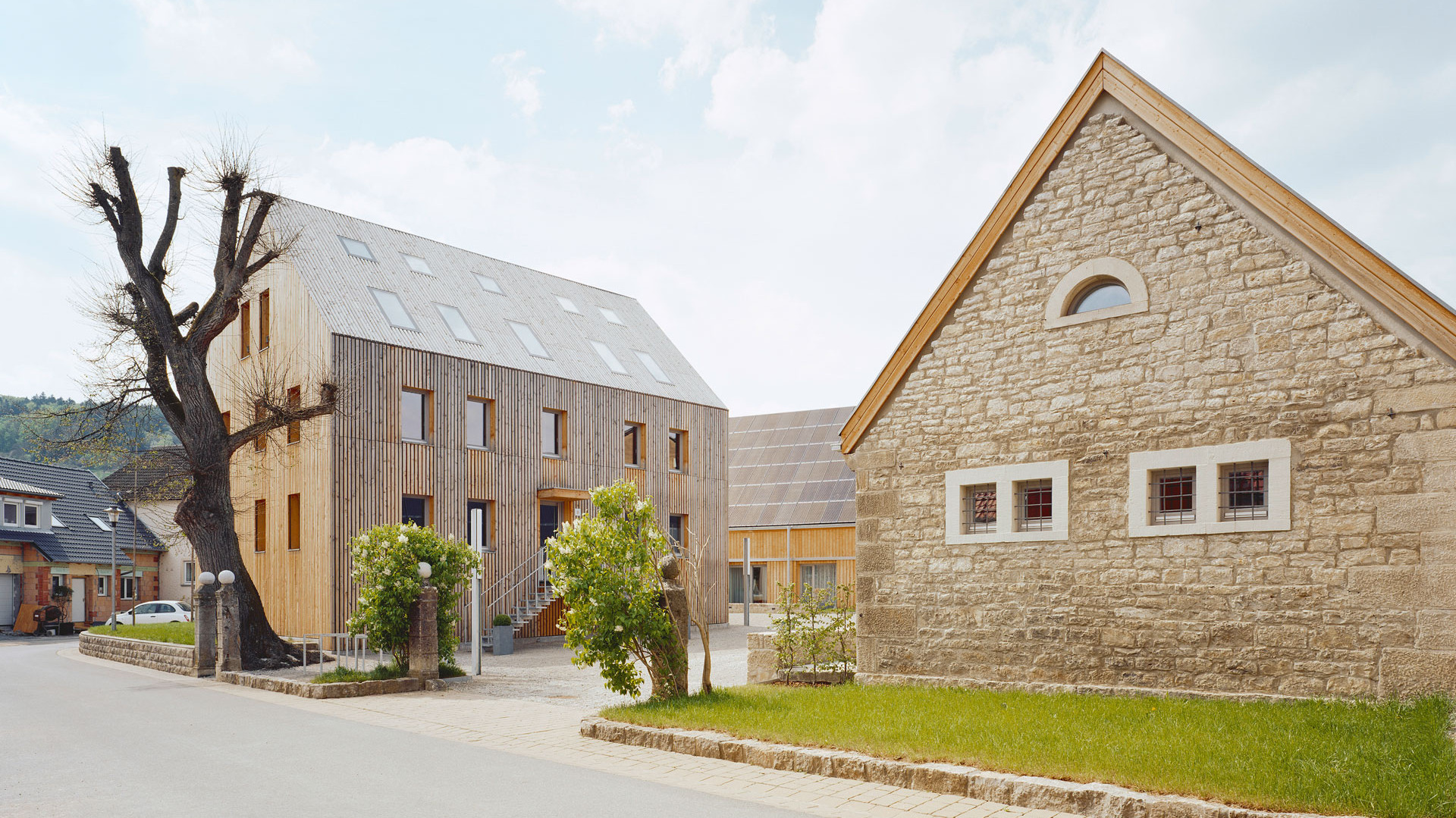
HOF8, Weikersheim-Schäftersheim
Formerly used for agricultural purposes, this complex of buildings was saved from demolition after standing derelict for a long time. By reusing available materials from the local area, it was renovated so that it would generate more energy than it consumed, and reactivated with a multigenerational utilisation concept.
You want to get actively involved in sustainable architecture yourself? Start here:
What if we exploited every opportunity to use buildings as sources of raw materials?
Moving away from the principle of quick demolition, and instead emphasizing the need to investigate and plan what should be done with a deconstructed building’s materials once they have been removed. This is the approach taken by the DGNB’s certification system for the sustainable deconstruction of buildings. At its core are five fundamental principles: 1. Create transparency, 2. Identify hazardous substances, 3. Optimise recycling and disposal, 4. Keep the focus on people and 5. Improve and expand existing deconstruction processes.
What if every building had a plan for how to become carbon neutral?
The political goal of carbon neutrality will in future apply to all buildings. For this to be economically viable rather than remaining a theoretical construct, a systematic approach is needed. A plan that sets out which measures can be used to attain the required improvements in CO2 accounting and at what time. In response to this need, DGNB has developed the principle of drawing up Climate Action Roadmaps for individual buildings. Based on real consumption values, they define measures to achieve carbon neutrality – with measurable interim targets, economic predictability and an appropriate timeframe.
Share your thoughts!
Want to share your thoughts on the topic or the exhibition? Feel free to use the visuals below.
If you're planning to post on LinkedIn, please link to us! To the DGNB Account
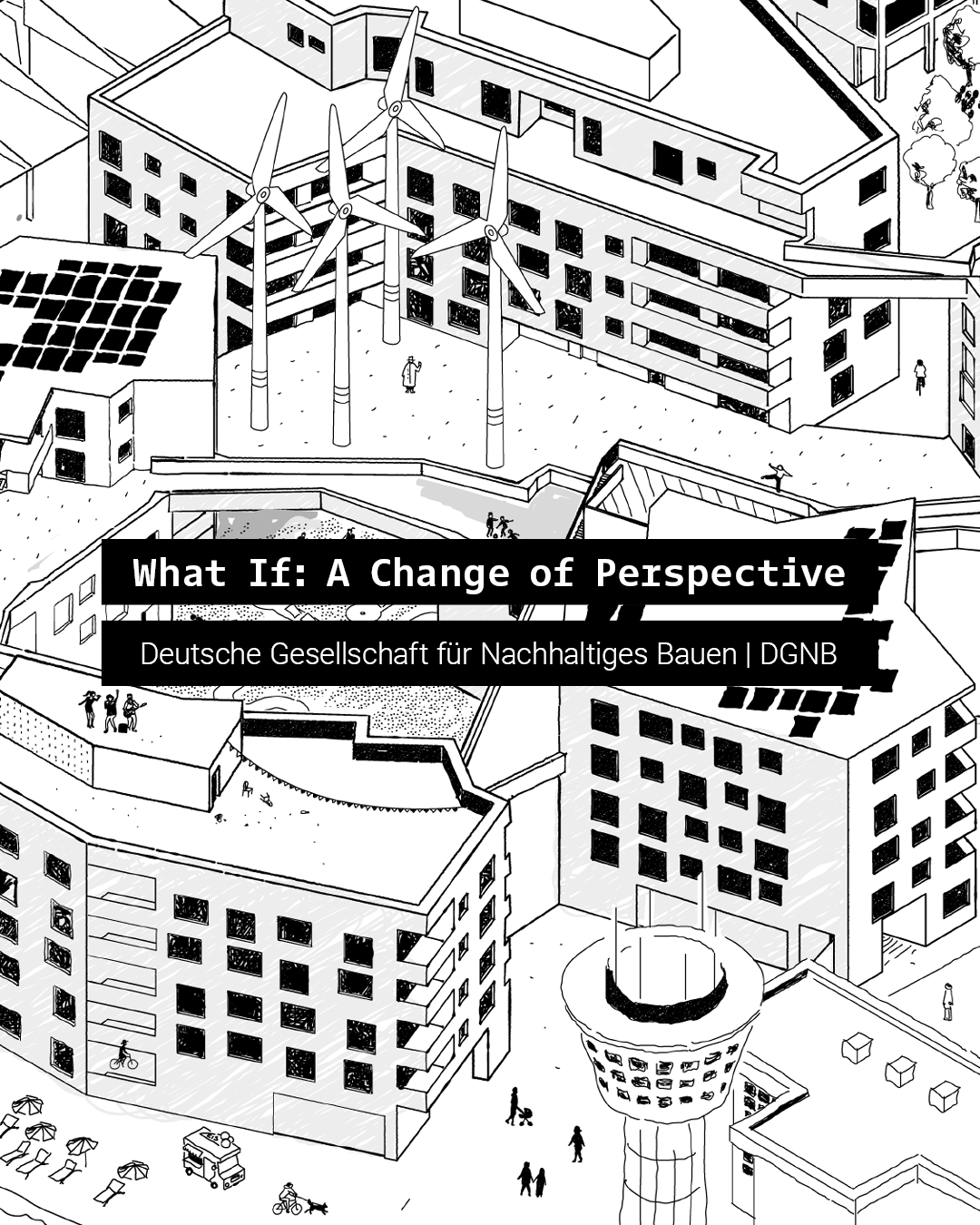
![[Translate to English:] Visual zur DGNB Ausstellung "What if: A Change of Perspective", Schwarz-Weiß-Zeichung im Hintergrund, Text im oberen Bereich auf farbigem Hintergrund: Was wäre, wenn wir nicht mehr neu bauen dürften?](/fileadmin/DGNB_eV/bilder_grafiken/diagramme_schaubilder/visual-dgnb-ausstellung-what-if-a-change-of-perspective-2025__5_.png "Land conservation and building stock preservation")
On to other topics covered by the exhibition
Your contact
Katrin Wolf
Deputy Director / Manager Trade Fairs, Events and Partnerships
- Phone: +49-711-722322-38
- Email: k.wolf@dgnb.de
Paul Bandowski
Project Manager Content Creation
- Phone: +49-711-722322-144
- Email: p.bandowski@dgnb.de