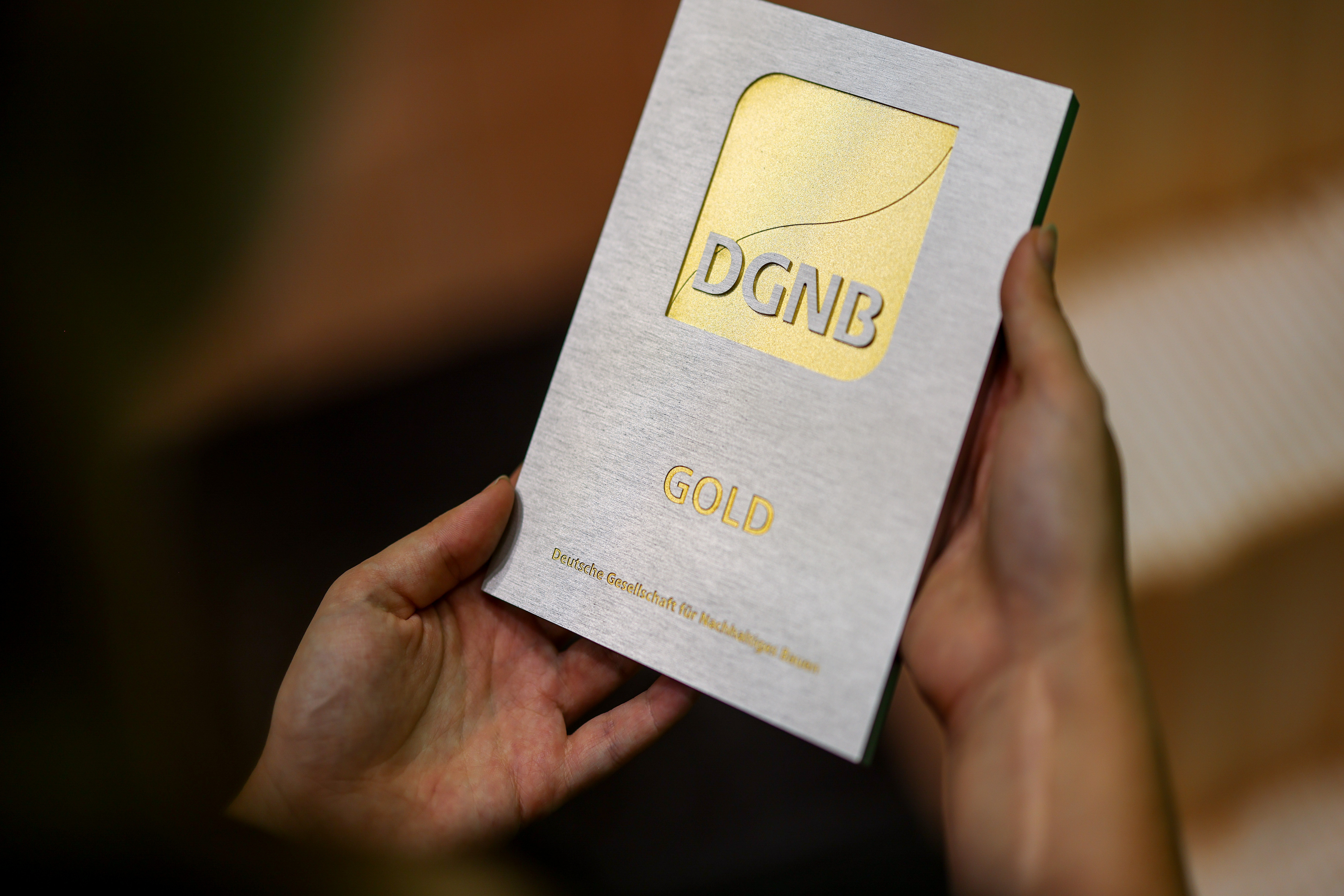
The practice of building certification has spread rapidly over the past two decades. In many countries, it is now standard practice to have construction projects certified to demonstrate their sustainability credentials. DGNB has played a pioneering role in this field compared to other certification bodies.
While other evaluation systems apply uniform requirements when used in different countries, thereby failing to account for regional considerations, DGNB takes a differentiated approach that specifically factors in local conditions and national legislation. The latest version of the DGNB System now goes a step further by adapting the most relevant benchmarks and the weightings of the relevant indicators within the certification process itself.
Unlike other systems, the DGNB System has taken a consistently holistic approach to sustainability from its very first version in 2009. Since then, many methods applied under DGNB standards have been written into policy, including life cycle assessment, life cycle costing and indoor air quality measurements. In addition to this, the DGNB has always set itself apart from other internationally recognised systems by taking a performance-based approach that goes beyond simply assessing measures and focuses on their actual impact.
It's no surprise that the DGNB is the undisputed market leader among certification system providers in Germany. However, the DGNB's approach is also gaining more popularity internationally. As of the end of 2025, over 15,000 projects have been certified according to the DGNB System, around 20 percent of which are outside Germany. There are DGNB-certified projects in 36 countries.
Revised criteria aligned with the most important international regulations
New buildings outside Germany are certified by DGNB using the international version of the DGNB System. The previous valid version from 2020 has been fundamentally revised and brought into line with the standards of the 2023.2 version of the DGNB System valid for the certification of new construction projects in Germany. The number of criteria was reduced significantly, the requirements formulated more simply, and all tools associated with certification were optimised for user-friendliness.
All criteria have been aligned with the most important international policies and ISO standards. For use in other European countries, regulatory requirements such as the EU taxonomy and the EU Energy Performance of Buildings Directive (EPBD) are fully covered in the criteria set. Regional variations such as climatic considerations, water availability on site, and specific cost factors are likewise accounted for in the criteria. The system is also designed to serve as a basis for green finance so that building owners can easily extract the key metrics needed for reporting purposes.
Issues that will become increasingly significant in future, such as biodiversity, climate adaptation, water, climate and resource protection, are all addressed in full in the criteria set. Social aspects and the avoidance of pollutants also continue to play a central role, while sufficiency – in the sense of using no more than is strictly necessary – serves as an overarching guiding principle. The certification therefore provides an incentive to retain parts of the existing building stock, as this leads to a better rating in the life cycle and circularity criteria.
"The new version of the international DGNB System isn't just a practical, forward-looking and ambitious certification system that helps to improve our built environment project by project," says Johannes Kreissig, CEO of DGNB. "It's also an expression of our vision of good, future-proof planning and construction. For those who want more than just an assessment but to plan and deliver a future-proof building that delivers real added value, DGNB Certification is the first choice."
Downloadable criteria set and digital information event
Much more information on the revised 2026 version of the DGNB System for the new construction of buildings outside Germany is available online at www.dgnb.de/certification/international, where the complete criteria set can also be downloaded. In addition, DGNB is running a digital introduction event on the topic for anyone who is interested. This will be held in English at 2.30 pm on 28 September 2026. Registration is via the above website.