
DGNB System New Construction, Buildings: Version 2023.2
The DGNB's goal is to promote sustainable construction practices across the board. The DGNB System for New Construction is a key instrument in achieving this objective. This tried-and-tested management and optimisation tool is regularly revised and adapted to reflect current conditions and market developments. However, in light of the global crises of recent years and the resulting challenges for the construction and property sectors, the DGNB has acknowledged that version 2023 of the system did not integrate as seamlessly into construction processes as anticipated. A key reason for this was the associated documentation requirements and workload. We have taken this feedback on board.
The criteria set out in version 2023.2 of the DGNB System for New Construction are the result of an intensive participatory process involving many experienced DGNB Senior Auditors. Every single indicator across all criteria was critically examined for the revision. The outcome is a certification system that is much more streamlined, noticeably reducing the workload without significantly lowering the level of ambition. This is evident not so much in the number of criteria (28 instead of 29), but rather in the number of underlying indicators (20 per cent fewer than before). Some minimum requirements have been reworded to make them more applicable to current design and construction practices, so as not to categorically exclude projects on the basis of minor details. Compatibility with the EU taxonomy or QNG is still guaranteed.
Important note on the system versionCertification in accordance with the DGNB System for New Construction, versions 2023 and 2023.2, is currently possible. Submissions for certification in accordance with version 2023 continue to be accepted until 30 September 2026. From 1 October 2026, version 2023.2 will replace version 2023 as the valid market version. |
DGNB Criteria Set, New Construction, Buildings, Version 2023.2
The DGNB System for New Construction, Version 2023.2, is based on the three key sustainability areas of ecology, economy and socio-cultural aspects, each of which accounts for 25 per cent of the evaluation. To ensure a holistic approach, the DGNB System also evaluates the site (5 per cent) and the technical and procedural quality (10 per cent each).
In total, the system comprises 28 criteria, distributed across the topic areas as follows:
- Environmental quality: 6 criteria
- Economic quality: 4 criteria
- Socio-cultural and functional quality: 6 criteria
- Technical quality: 4 criteria
- Process quality: 5 criteria
- Site quality: 3 criteria
Please note that not all criteria are relevant to every scheme. The weighting of the individual criteria may vary depending on the scheme.
Work aids for climate risk analysis and climate adaptation
- List of providers and products for professional climate risk services (assessment – management – reduction)
- Collection of freely available online resources on environmental hazards caused by climate – nature – civilisation
- Overview of possible adaptation measures for climate hazards (heat – drought | heavy rain – flooding | thunderstorms – hail)
- Strategic work aid incl. possible measures for local authorities to use in their heat action planning
Certification requirements
At the time of certification, the building should not have been completed or commissioned more than three years ago. If it is intended to certify a new building that was completed or commissioned more than three years ago, this must be agreed with the DGNB office via a project-specific request for certifiability (PCQ) by a DGNB Auditor before the project is registered. As a rule, it is always possible to certify a building according to the current system.
The principle of minimum requirements applies to all those aspects that are non-negotiable for the sustainable planning and construction of a property, with a view to its future viability.
Minimum requirements sorted by criteria for all buildings:
- ENV1.1: Calculating the life-cycle GHG balance and creating a phase-out plan for the use of fossil fuels
- SOC1.2: TMeasuring indoor air quality to meet the minimum requirements for evaluating indoor air concentrations of volatile organic compounds, excluding industry and commerce
- SITE1.1: Conducting a climate risk analysis of a minimum scope
Where individual regulations regarding minimum requirements exist for specific schemes, these are listed in the criteria set under the section 'Scheme-specific details'.
Expert reports, analyses and simulations must make reference to the current planning status or the building as it was actually constructed. If expert reports and simulations made reference to a previous planning status, evidence must be provided to clearly demonstrate that they continue to be valid and relevant.
Primary use: The scheme with the largest share of the total DGNB assessment area is designated as the primary use. In the case of mixed use, the scheme with the largest share of space is designated as the primary use. If classification is not clearly possible (e.g. 40 percent office, 40 percent residential, 20 percent commercial building), the auditor must determine the primary use and justify the decision.
Secondary use: One or more uses that are assigned to a different scheme than the primary use and whose area share of the total DGNB assessment area is ≥ 15% are referred to as secondary use. The areas of a secondary use must be evaluated with the corresponding scheme. If there is at least one secondary use, the building under consideration must be evaluated according to the mixed use application rules.
Subordinate use: One or more uses that are assigned to a different scheme than the primary use and whose area share is < 15 % (or in case of several schemes < 30 %) of the DGNB assessment area are referred to as subordinate use. These areas are to be assigned to the primary use and are to be evaluated according to the primary use scheme. If there are several secondary uses < 15% of DGNB assessment area and the sum of their area shares in the DGNB assessment area is ≥ 30%, the subordinate use with the largest area share is to be considered as secondary use.
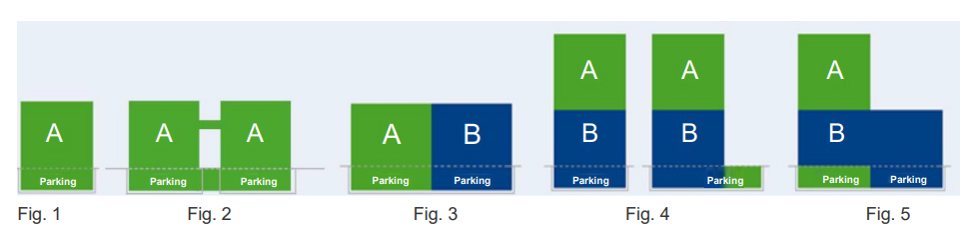
Certification is possible as a single certification, ensemble certification and multiple or serial certification. Unless otherwise stated in the individual criteria, only the building and the open spaces directly associated with it are considered.
Standard case: One certificate for the entire building
Single building:
- A building structure with one or more uses.
Connected building structures (same use or mixed use):
- Two or more building structures that are permanently connected either above ground (e.g. bridge, podium) or underground (e.g. underground garage).
For buildings with multiple uses, the DGNB delimitation rules for mixed use must be followed.
The uses/structures may be certified separately if a physical separation of the different uses/structures is possible (i.e. they can function independently) and this is reflected in the building’s appearance. Parameters to be met and coordination are the same as for DGNB partial certification.
A certificate for multiple buildings within a system boundary is possible on a project-specific basis and must be agreed with the DGNB on a case-by-case basis (PCQ enquiry within the DGNB System Software).
If a deviating certification is intended, this must be agreed with the DGNB office via a project-specific certifiability enquiry (PCQ) in the DGNB System Software through the auditor prior to the project’s registration.
Several buildings on one property

Ensemble certification is possible for buildings on a site that are largely identical in construction. This can be carried out on the basis of any existing scheme and enables a DGNB Pre-certificate or Certificate to be issued for each building individually, using a collective set of supporting documents and with reduced documentation requirements. If the buildings are pre-certified, the audit, inspection and evaluation are carried out for the entire complex.
For certification, a typical building (base module) must be fully documented. For the remaining buildings, which are largely identical in construction, the evidence must be provided cumulatively. Based on the criteria set, a statement must be made for each criterion as to whether there are any deviations from the base module. These must be documented in detail, as must the quality documentation following completion, such as indoor air quality measurements (to be carried out in every building). Irrespective of this, cross-criteria documentation such as floor area summaries, plans, completion date/stage, GEG calculation, etc., must be submitted for each building. Evidence may be omitted by referring to the basic module if the details are identical. Furthermore, a list of criteria must be drawn up for every building in which synergy effects relevant to the assessment come into play (e.g. shared use of a canteen).
The ensemble certification must be agreed with the DGNB Office via a project-specific request (PCQ) in the DGNB System Software by a DGNB Auditor before the project is registered.
More about ensemble certification
Identical buildings at different locations
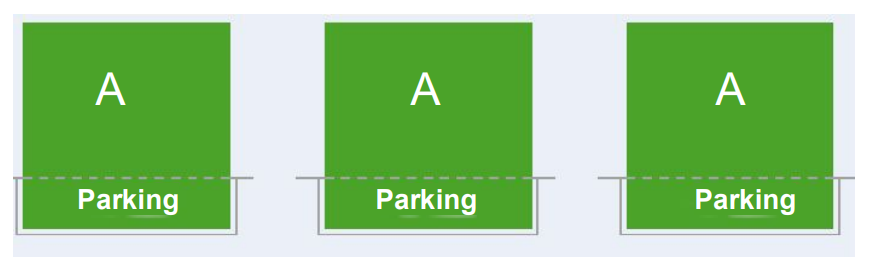
This form of certification is applied to buildings with the same use and comparable typology (e.g. consumer markets, hotels, prefabricated houses, etc.) that are constructed identically at different sites. In the case of multiple and serial certification, a basic standard—which is identical for all buildings—is evaluated on the basis of the model building specification and the requirements of the respective DGNB System. The form of certification known as series certification is carried out exclusively on the basis of the DGNB System Small Residential Buildings, Renovation and New Construction for new builds. Multiple certification, on the other hand, is applied to all DGNB schemes, except for the new construction of small residential buildings. Every building constructed on the basis of this basic-certified building specification receives an individual DGNB Certificate following the submission and review of the relevant documentation.
More about multiple certification
Frequently asked questions
You can already register projects for certification under the DGNB System for New Construction, Buildings, Version 2023.2 via the DGNB System Software.
Once you have logged in, you will receive the relevant contract. The criteria are expected to be available in the DGNB System Software from July 2026 onwards.
It is currently possible to apply for certification in accordance with the DGNB System for New Construction, Buildings, Versions 2023 and 2023.2.
Registration for version 2023 remains open until 30 September 2026. From 1 October 2026, version 2023.2 will fully replace version 2023 as the valid market version.
For certification in accordance with version 2023.2, the DGNB’s current scale of fees for New Construction applies.
Yes, a change is possible. Please note the following points:
- To request a switch to the 2023.2 version, please send an email to system@dgnb.de.
- Contracting parties will subsequently receive an addendum to the existing contract
- The DGNB will convert the project in the DGNB System Software. In doing so, all fields already completed and supporting documents will be lost. Please back up any documents and supporting evidence already uploaded before the change!
- Project number: The existing project number (contract number) will be updated to the new version (e.g. NBV23.2-DE-xxxxxx)
No, it is not possible to mix criteria from different versions.
An exception is Annex 1 of criterion ENV1.2. Here, the current Annex 1 from version 2023.2 may be used. It is also possible to switch to version 2023.2 for individual lines of Annex 1 being used. The trade-by-trade documentation in version 2023.2 is also accepted as a “bill of quantities” or “comparable to a bill of quantities”. Furthermore, even for version 2023 and older projects, the extended options for incorrect applications may be used within the framework of site inspections under version 2023.2 (see Annex 5). Please explain the chosen variant and option in the explanatory report.
Addressing the following criteria is supported by tools:
- ENV1.1 Climate Action and Energy
- ENV2.2 Potable water demand and waste water volume
- ECO1.1 Building-related life-cycle costs
- SOC2.1 Design for all
The tools are currently being updated and will shortly be made available in the DGNB System Software.
The use of the DGNB Building Resource Passport and the newly developed Circularity Check is recognised under criterion TEC1.6 Circular construction.
Information on the DGNB Building Resource Passport can be found here.
The Circularity Check is currently obly available in German and will shortly also be made available via the toolbox “Circular Building”. From July 2026, it is expected to be included in the DGNB System Software in the final release of version 2023.2.
There are no specific requirements regarding life cycle assessment tools. Consequently, both professional solutions and in-house tools may be used. If professional tools are used, you will find an overview here for guidance; please note that this list is not exhaustive and in German. The information contained therein is based on the tool providers’ own declarations and has not been verified by the DGNB.
In addition, the DGNB is working on a recognition for LCA software.
There is currently no standardised procedure for identifying and evaluating climate risks in structural installations and properties. Guidance is provided by the general guideline on the evaluation of vulnerability and climate risks, DIN EN ISO 14091:2021-07, as well as regulatory requirements (e.g. the EU taxonomy) or approaches developed by private providers. There is no set rule regarding which tools or providers should be used to carry out a climate risk analysis, for example for criterion SITE1.1 in the DGNB System or for ESG Verification for the EU Taxonomy. Professional solutions, in-house tools or freely available sources may all be used. Further up on this page, you will find various working and guidance materials in the form of Excel documents available for download, including:
- An overview featuring a selection of providers and products for climate risk services, which can assist in choosing a product suitable for the project (for the specific requirements of a taxonomy-compliant Climate risk analysis, e.g. regarding the climate impacts considered and future data)
- A filterable overview of geo-portals and online resources on climate and environmental hazards (in case you are carrying out the Climate risk analysis yourself)
- A guide to potential climate adaptation measures across all topics
- A locally adaptable working aid for the specific challenge of heat protection planning at municipal level, developed in cooperation with the Climate Positive Cities and Communities Initiative
Please note: Those are currntly only available in German.
When developing version 2023.2 of the DGNB System for New Construction, care was taken to integrate the requirements of the QNG quality seal for sustainable buildings into the certification system, so that parallel processing is possible. The system has achieved recognition from DAkkS (national accreditation unit of the Federal Republic of Germany) since 27 May 2024. Due to the frequent short-notice changes to funding criteria, we generally recommend checking the currently applicable regulations at the start of a project.
The 2023.2 version of the DGNB System for New Construction was developed with the integration of the current EU taxonomy requirements in mind. Parallel processing is possible. The system basics include a process description explaining how the DGNB ensures that the system remains up to date in future revisions (e.g. of the taxonomy requirements).
In Hamburg, there are four major urban development projects being led by HafenCity Hamburg GmbH and its subsidiaries: HafenCity, Billebogen, Grasbrook and Science City Hamburg Bahrenfeld. In an effort to consistently implement uniform sustainability standards across these districts, sustainability certification through the Implementation of HafenCity’s own certification system, the ‘HafenCity Ecolabel’, has been a prerequisite for the allocation of land since 2010. In 2023, this was replaced by a new award developed in cooperation with the DGNB: the DGNB special award Ecolabel. The DGNB special award Ecolabel incorporates key aspects of the previously independently administered 'HafenCity Ecolabel' and combines them with the benefits of the DGNB System.
An update is currently underway to adapt the scheme to version 2023.2.
Yes, the title of DGNB Auditor entitles the holder to submit new construction projects, regardless of the version. Information on the content is available through information events, the DGNB criteria set itself and the DGNB Expert Days.
For anyone wishing to become a DGNB Consultant:
The training offered by the DGNB Academy is based on the latest market versions of the DGNB System variants. The training materials are currently being updated. Once the market version for new construction, version 2023.2, is officially released (expected in July), the course content for the DGNB Consultant programme will also be updated.
For DGNB Consultants and DGNB Auditors:
Version 2023.2 will also be presented at the DGNB Academy’s Expert Days. You can find the latest overview of the Expert Days here on the DGNB website.
For participants in the trial phase, the agreed general conditions remain the same: certification based on the trial version is possible provided that the documentation is submitted by 13 July 2026. After 12 May 2026, the only change will be to the registration procedure for projects that were part of the trial phase but haven't yet been registered. Please register these in the DGNB System Software for version 2023.2 and then send an email to system@dgnb.de stating that the registration is to be made for the trial version.
The further development of the DGNB System for New Construction to version 2023.2 began with an in-depth consultation with users. The starting point was a ‘mini-conference’ with DGNB Senior Auditors, who provided us with a wide range of feedback and shared their experiences of applying version 2023. Experiences from audits, our consultation sessions and our ongoing work on various topics were also collected, evaluated and taken into account.
The revision process involved DGNB Auditors and Consultants, members of various DGNB committees (particularly the DGNB Technical Committee), the DGNB management and DGNB staff.
During the public commenting phase, all interested parties were able to provide us with feedback. This opportunity was widely taken up and was also incorporated into the revision process.
The trial phase was particularly intensive, during which we tested the new version on real-world projects with a group of around 30 test users and conducted workshops on the criteria. The final version was then approved during a two-day meeting of the DGNB Technical Committee.
Get in touch
If you have any questions or comments regarding the DGNB System for New Construction, Buildings, Version 2023.2, please feel free to contact our team at any time!
Email: 2023.2@dgnb.de