
DGNB System New Construction, Buildings: Version 2023
Note on the system versionIn response to changing market conditions and the resulting calls for less bureaucracy and reduced administrative burden in the certification process, the DGNB has spent the past few months closely examining how the system can be simplified without compromising on its substantive ambitions, and has specifically refined the DGNB System for New Construction under the name 'Version 2023. 2'. It is currently possible to apply for certification in accordance with the DGNB System for New Construction in versions 2023 and 2023.2. Applications for version 2023 can be submitted until 30 September 2026. From 1 October 2026, Version 2023.2 will completely replace Version 2023 as the valid market version. |
Certification criteria
The DGNB system does not evaluate individual measures, constructions or components, but the overall performance of a building based on criteria. If these criteria are met in an outstanding manner, the building receives a certificate or pre-certificate in Platinum, Gold or Silver.
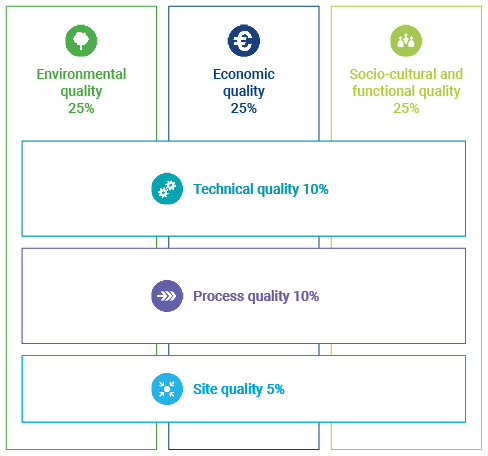
The DGNB System for New Construction of Buildings, Version 2023 is based on the three central sustainability areas of environmental, economic and sociocultural aspects, which are given equal weighting of 25 per cent in the assessment. In terms of a holistic approach, the DGNB System also assesses the location with 5 per cent and the technical and process-related quality with 10 per cent each.
The system comprises a total of 29 criteria, the number of which is distributed across the topic areas as follows:
- Environmental quality: 6 Criteria
- Economic quality: 4 Criteria
- Sociocultural and functional quality: 6 Criteria
- Technical quality: 4 Criteria
- Process quality: 6 Criteria
- Site quality: 3 Criteria
It should be noted that not every criterion is relevant for every scheme. Depending on the scheme, the weighting of the individual criteria may vary. You can download the complete DGNB criteria set below.
The criteria of environmental quality allow an assessment to be made with regard to the effects of buildings on the global and local environment as well as the impact on resources and the generation of waste.
- Climate action and energy (ENV1.1)
- Local environmental impact (ENV1.2)
- Responsible resource extraction (ENV1.3)
- Potable water demand and waste water volume (ENV2.2)
- Land use (ENV2.3)
- Biodiversity at the site (ENV2.4)
The criteria of sociocultural and functional quality help to assess buildings with regard to health, comfort and user satisfaction as well as the essential aspects of functionality.
- Thermal comfort (SOC1.1)
- Indoor air quality (SOC1.2)
- Sound insulation and acoustic comfort (SOC1.3)
- Visual comfort (SOC1.4)
- Quality of indoor and outdoor spaces (SOC1.6)
- Barrier-free design (SOC2.1)
The criteria of process quality aim to increase the planning quality and the construction quality assurance.
- Quality of project preparation (PRO1.1)
- Ensuring sustainability aspects in tendering and contracting (PRO1.4)
- Procedure for urban and design planning (PRO1.6)
- Construction site / construction process (PRO2.1)
- Systematic commissioning (PRO2.3)
- Preparation for sustainable use (PRO2.5)
Work aids for climate risk analysis and climate adaptation
- List of providers and products for professional climate risk services (assessment – management – reduction)
- Collection of freely available online resources on environmental hazards caused by climate – nature – civilisation
- Overview of possible adaptation measures for climate hazards (heat – drought | heavy rain – flooding | thunderstorms – hail)
- Strategic work aid incl. possible measures for local authorities to use in their heat action planning
Certification requirements
At the time of certification, the building should not have been completed or commissioned more than three years ago. If it is intended to certify a new building that was completed or commissioned more than three years ago, this must be agreed with the DGNB Office via a project-specific request for certifiability (PCQ) by a DGNB Auditor before the project is registered. As a rule, it is always possible to certify a building according to the current system.
The principle of minimum requirements is applied to all those issues that are non-negotiable for a sustainably planned and built property with a view to its future viability. Some minimum requirements are mandatory in order to be certified at all. Others are required to achieve a DGNB Certificate in Platinum, the highest level awarded.
Minimum requirements by criteria for all buildings:
- ENV1.1: Disclosure of life cycle assessments and, for buildings not yet designed for net greenhouse gas neutral operation at the time of completion, a "Climate Action Roadmap for Climate Neutral Operation - Target Year According to National Targets".
- ENV1.3: It must be demonstrated that at least 50 percent (by mass) of the permanently installed wood or wood-based materials used is sourced from certified sustainably managed sources.
- ECO2.6: For all buildings, there is a "basic resilience" to climate risks.
- SOC1.2: The indoor air quality measurement meets the minimum requirements for the assessment of indoor air concentration of volatile organic compounds.
- SOC2.1: Accessibility: Compliance with quality level QS1. This must be complied with for all uses (main, secondary and subordinate uses). Exceptions can be found in Table 2 in the criterion.
- TEC1.6: It must be demonstrated that circular aspects are taken into account in planning and implementation. For this reason, as a minimum requirement for certifiability, a deconstruction manual must be submitted or the minimum score of 20 points in the entire criterion must be demonstrated.
- PRO2.3: Development of an energy monitoring concept.
- SITE1.1: A climate risk analysis is available.
Minimum requirements for buildings seeking DGNB Certification in Platinum:
- ENV1.1: Disclosure of life cycle assessments and, for buildings that are not yet designed for net greenhouse gas neutral operation at the time of completion, an "Ambitious Climate Action Roadmap" for climate neutral operation.
- ENV1.2: Compliance with quality level QS3.
- ENV2.2: For a Platinum certificate, 40 points must be achieved in the criterion.
- ENV2.4: For indicator 2 "Habitat" a minimum of 25 points is required.
- ECO2.6: Significant measures to reduce all risks classified as high at the site are being implemented.
- SOC1.2: In mechanically ventilated buildings, the measurement and assessment of indoor air quality results in a TVOC indoor air quality value of less than 1000 μg/m³ and a formaldehyde value of less than 60 μg/m³.
- TEC1.4: Energy generation at the building: For the award level Platinum, a score of 5 points must be achieved in indicator 5.2.1.
- TEC1.6: For the DGNB Certificate in Platinum, if deconstruction has taken place, a justification for the deconstruction must be provided and (also applies to projects without prior deconstruction) the minimum score of 40 points in the overall criterion must be demonstrated.
- TEC3.1: A minimum score of 40 points must be demonstrated in the entire criterion.
- PRO2.3: Commissioning of the regulation monitoring is available.
- SITE1.1: A qualified climate risk analysis is available.
If individual regulations exist for individual schemes with regard to the minimum requirements, these are listed in the criteria set under the section "scheme-specific information".
Expert reports, analyses and simulations must make reference to the current planning status or the building as it was actually constructed. If expert reports and simulations made reference to a previous planning status, evidence must be provided to clearly demonstrate that they continue to be valid and relevant.
Primary use: The scheme with the largest share of the total DGNB assessment area is designated as the primary use. In the case of mixed use, the scheme with the largest share of space is designated as the primary use. If classification is not clearly possible (e.g. 40 percent office, 40 percent residential, 20 percent commercial building), the auditor must determine the primary use and justify the decision.
Secondary use: One or more uses that are assigned to a different scheme than the primary use and whose area share of the total DGNB assessment area is ≥ 15% are referred to as secondary use. The areas of a secondary use must be evaluated with the corresponding scheme. If there is at least one secondary use, the building under consideration must be evaluated according to the mixed use application rules.
Subordinate use: One or more uses that are assigned to a different scheme than the primary use and whose area share is < 15 % (or in case of several schemes < 30 %) of the DGNB assessment area are referred to as subordinate use. These areas are to be assigned to the primary use and are to be evaluated according to the primary use scheme. If there are several secondary uses < 15% of DGNB assessment area and the sum of their area shares in the DGNB assessment area is ≥ 30%, the subordinate use with the largest area share is to be considered as secondary use.
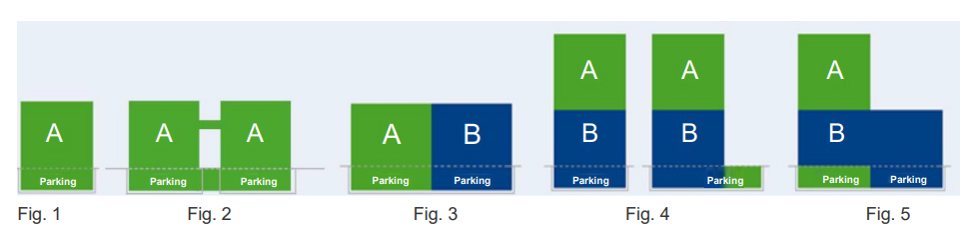
Certification is possible as a single certification, ensemble certification and multiple or serial certification. Unless otherwise stated in the individual criteria, only the building and the open spaces directly associated with it are considered.
Standard case: One certificate for the entire building
Single building:
- A building structure with one or more uses.
Connected building structures (same use or mixed use):
- Two or more building structures that are permanently connected either above ground (e.g. bridge, podium) or underground (e.g. underground garage).
For buildings with multiple uses, the DGNB delimitation rules for mixed use must be followed.
The uses/structures may be certified separately if a physical separation of the different uses/structures is possible (i.e. they can function independently) and this is reflected in the building’s appearance. Parameters to be met and coordination are the same as for DGNB partial certification.
A certificate for multiple buildings within a system boundary is possible on a project-specific basis and must be agreed with the DGNB on a case-by-case basis (PCQ enquiry within the DGNB System Software).
If a deviating certification is intended, this must be agreed with the DGNB office via a project-specific certifiability enquiry (PCQ) in the DGNB System Software through the auditor prior to the project’s registration.
Multiple certificates
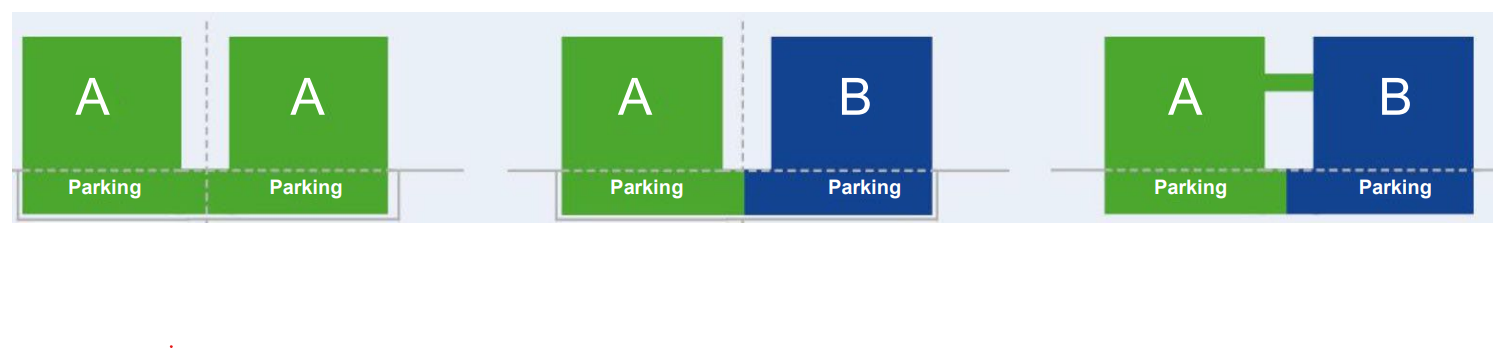
Buildings must be certified separately if the building structures are clearly distinct from one another. The underground garage must be allocated to the relevant building structures in accordance with the parking space verification.
If a deviating certification is intended, this must be agreed with the DGNB office via the auditor using a project-specific request for certifiability (PAZ) in the DGNB System before the project is registered.
Several buildings on one property

Ensemble certification is possible for buildings on a site that are largely identical in construction. This can be carried out on the basis of any existing scheme and enables a DGNB Pre-certificate or Certificate to be issued for each building individually, using a collective set of supporting documents and with reduced documentation requirements. If the buildings are pre-certified, the audit, inspection and evaluation are carried out for the entire complex.
For certification, a typical building (base module) must be fully documented. For the remaining buildings, which are largely identical in construction, the evidence must be provided cumulatively. Based on the criteria set, a statement must be made for each criterion as to whether there are any deviations from the base module. These must be documented in detail, as must the quality documentation following completion, such as indoor air quality measurements (to be carried out in every building). Irrespective of this, cross-criteria documentation such as floor area summaries, plans, completion date/stage, GEG calculation, etc., must be submitted for each building. Evidence may be omitted by referring to the basic module if the details are identical. Furthermore, a list of criteria must be drawn up for every building in which synergy effects relevant to the assessment come into play (e.g. shared use of a canteen).
The ensemble certification must be agreed with the DGNB Office via a project-specific request (PCQ) in the DGNB System Software by a DGNB Auditor before the project is registered.
More about ensemble certification
Identical buildings at different locations
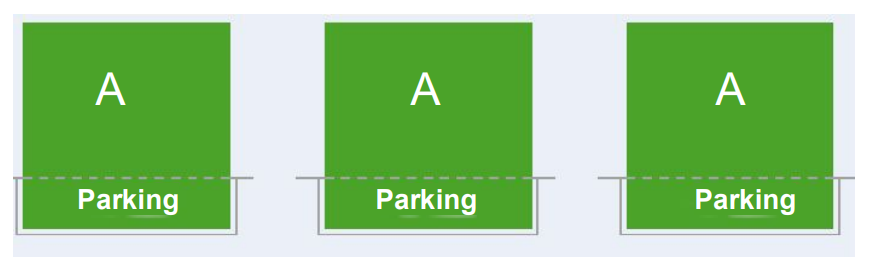
This form of certification is applied to buildings with the same use and comparable typology (e.g. consumer markets, hotels, prefabricated houses, etc.) that are constructed identically at different sites. In the case of multiple and serial certification, a basic standard—which is identical for all buildings—is evaluated on the basis of the model building specification and the requirements of the respective DGNB System. The form of certification known as series certification is carried out exclusively on the basis of the DGNB System Small Residential Buildings, Renovation and New Construction for new builds. Multiple certification, on the other hand, is applied to all DGNB schemes, except for the new construction of small residential buildings. Every building constructed on the basis of this basic-certified building specification receives an individual DGNB Certificate following the submission and review of the relevant documentation.
More about multiple certification
Frequently asked questions
The DGNB is pursuing the following goals with the 2023 system version:
- Sharpening requirements, especially with regard to future climate goals
- Streamlining the system by reducing criteria / indicators
- Quality assurance through additional minimum requirements
- Improving the linking of the various DGNB Systems
- Integration of the requirements of the Sustainable Building Quality Seal (QNG) and the EU taxonomy
- General optimisation of the application and elimination of inaccuracies
In part. The aim of the new version of the system is to make buildings sustainable. This means a higher level of ambition than in the 2018 version with regard to issues such as climate action, resource conservation, climate adaptation and mobility.
Other criteria, particularly in the area of sociocultural quality, have also had to be adapted due to changes in the DIN standards. This represents a change, but not necessarily a tightening.
In addition, some criteria, such as sound insulation, have been dropped.
There are no specifications for life cycle assessment tools. Therefore, both professional solutions and your own tools can be used. If professional tools are used, you will find an overview here for your guidance, without any claim to completeness. The information provided is self-declarations by the tool providers and has not been checked by the DGNB. In addition, the DGNB will shortly be offering an accreditation of life cycle assessment tools, which will confirm the accuracy of the calculations and use of data. The DGNB CO2 calculator can be used to create a climate action roadmap. Further information on life cycle assessment can be found here.
Currently, there is no standardised procedure for assessing and evaluating climate risks in buildings and real estate. Guidance is provided by the general guideline for assessing vulnerability and climate risks (DIN EN ISO 14091:2021-07), as well as regulatory requirements (e.g. the EU taxonomy) and approaches from private providers. There are no specifications as to which tools or providers are used to perform a climate risk analysis, e.g. for criterion SITE1.1 in the DGNB System or ESG Verification for the EU Taxonomy. Professional solutions, proprietary instruments or freely available sources can all be used. Further up on this page, you will find various work and guidance aids in the form of Excel documents for download, including:
- An overview with a selection of providers and products for climate risk services, which can help you choose a product that is suitable for your project (for the specific requirements of a taxonomy-compliant climate risk analysis, e.g. with regard to climate impacts and future data considered)
- A filterable overview of geo-portals and online resources on climate and environmental hazards (in case you are conducting the climate risk analysis yourself)
- A guide to possible climate adaptation measures across all subject areas
- A locally adaptable work aid for the specific challenge of heat protection planning at the municipal level, developed in cooperation with the 'Klimapositive Städte und Gemeinden' (Climate-Positive Cities and Municipalities) initiative.
When developing the criteria, the requirements from the systems/classifications mentioned were taken into account. Information on overlaps and synergies can be found in the respective system harmonisation documents. Anyone who carries out DGNB Certification will not have any parallel documentation work, but can use the DGNB Certificate as a verification instrument for national and international requirements. In the criteria set, the relevance of the individual DGNB criteria for the respective systems is marked with an icon.
In the development of version 2023, care has been taken to integrate the requirements of the quality label "Qualitätssiegel Nachhaltiges Gebäude" into the certification system to allow parallel processing. The new system version has been recognized by the DAkkS (German Accreditation Body) since 27 May 2024. As funding criteria are often changed at relatively short notice, it is advisable to check the current regulations at the start of a project.
The DGNB System New Construction of Buildings, Version 2023 only covers residential buildings with at least six units.
Projects for small residential buildings and apartment buildings with up to twelve units can be registered with the DGNB System Small Residential Buildings Renovation / New Construction, Version 2024 (in German).
For the further development of the DGNB System for New Construction to the 2023 version, extensive research and an intensive dialogue took place first. DGNB auditors and consultants, members of various DGNB committees (in particular the DGNB Technical Committee), DGNB management and DGNB employees were involved in this process.
A plan for the revision was drawn up on the basis of the extensive feedback. This was approved by the DGNB Technical Committee and the DGNB Management Board. A project team made up of DGNB employees from the Certification and Research and Development departments then revised the criteria in line with this plan.